Eilat Mazar gave a brief presentation at the important Herzliya conference today and that is now available in video format online.  She spoke for 8 minutes and the video includes the slides she showed in her presentation.  In the last two minutes, she discussed the discovery of the “Temah” seal, but made no mention of the alternate reading of Shlomit.  If you’re not aware of this discussion, see the updates to the previous blog post.


Hebrew video


English video (translated)

Hebrew abstract

English abstract

HT: Joe Lauer and Yitzhak Sapir

Share:

Many seals have been found with the names of people mentioned in the Bible, but it’s always nice to find another. From the Jerusalem Post:

A stone seal bearing the name of one of the families who acted as servants in the First Temple and then returned to Jerusalem after being exiled to Babylonia has been uncovered in an archeological excavation in Jerusalem’s City of David, a prominent Israeli archeologist said Wednesday.
The 2,500-year-old black stone seal, which has the name “Temech” engraved on it, was found earlier this week amid stratified debris in the excavation under way just outside the Old City walls near the Dung Gate, said archeologist Dr. Eilat Mazar, who is leading the dig.
According to the Book of Nehemiah, the Temech family were servants of the First Temple and were sent into exile to Babylon following its destruction by the Babylonians in 586 BCE.
The family was among those who later returned to Jerusalem, the Bible recounts.
The seal, which was bought in Babylon and dates to 538-445 BCE, portrays a common and popular cultic scene, Mazar said.
The 2.1 x 1.8-cm. elliptical seal is engraved with two bearded priests standing on either side of an incense altar with their hands raised forward in a position of worship.

The rest of the article is here.

The article mentions the mention of Temech (spelled Temah in NIV, NAS and ESV) in Nehemiah 7:55, but not Ezra 2:53.

HT: Joe Lauer

UPDATE (1/17): The JPost article now includes a photo. And on the ANE-2 list, Peter van der Veen suggests that the inscription should be read the opposite way, thus sh-l-m-t or Shlomit.

UPDATE (1/19): Chris Heard has a good analysis, together with some helpful illustrations showing the suggested readings. From the discussion at ANE-2 and elsewhere, it seems that the majority of scholars favor the “Shlomit” reading. There is a Shlomit mentioned in the Bible from this time period as well, in Ezra 8:10.

UPDATE (1/31): Mazar now agrees with those who read the seal from left to right. For more, see this post.

Share:

Israel Finkelstein, Lily Singer-Avitz, Ze’ev Herzog, and David Ussishkin have written an article in the Tel Aviv journal entitled “Has King David’s Palace in Jerusalem Been Found?”  Jim West has posted the article in pdf format here (but after Jan 29 here).

The abstract:

Recent excavations at the City of David have revealed a set of massive walls constructed of large undressed stones. Excavator Eilat Mazar has presented them as the remains of a single building, which she labelled the ‘Large Stone Structure’. Mazar interpreted the ‘Large Stone Structure’ as part of a big construction complex, which had also included the ‘Stepped Stone Structure’ on the slope. She dated her ‘Large Stone Structure’ to ca. 1000 BCE and identified it as the palace of King David. We argue that: (1) the walls unearthed by Mazar do not belong to a single building; (2) the more elaborate walls may be associated with elements uncovered by Macalister and Duncan in the 1920s and should possibly be dated to the Hellenistic period; (3) the ‘Stepped Stone Structure’ represents at least two phases of construction— the lower (downslope) and earlier, possibly dating to the Iron IIA in the 9th century BCE, and the later (which connects to the Hasmonaean First Wall upslope) dating to the Hellenistic period.

Their brutal conclusion:

Eilat Mazar’s excavations in the City of David add several points of information to what we know about the history of this problematic site. Yet, the main find—the ‘Large Stone Structure’—was not properly interpreted and dated. First, it seems to consist of several elements, mainly a rectangular building in the west and the citywall in the east. Second, all one can safely say is that its various elements post-date the late Iron I/early Iron IIA and predate the Roman period. Circumstantial evidence seems to suggest the dating of most elements to the late Hellenistic period.
Beyond archaeology, one wonders about the interpretation of the finds. The biblical text dominates this field operation, not archaeology. Had it not been for Mazar’s literal reading of the biblical text, she never would have dated the remains to the 10th century BCE with such confidence. This is an excellent example of the weakness of the traditional, highly literal, biblical archaeology—a discipline that dominated research until the 1960s, that was weakened and almost disappeared from the scene in the later years of the 20th century, and that reemerged with all its attributes in the City of David in 2005.

Revising Mazar’s date from the 10th century to the 2nd-1st century is a huge correction (it reminds one of the 1000-year errors that Robert Alexander Stewart Macalister regularly made).  And this charge is made not in a casual conversation, but in a major journal. But the authors make no attempt to hide their own agenda: they hate “biblical archaeology.”  While Mazar is possibly guilty of finding what she is looking for, I have trouble imagining a scenario where Finkelstein would agree with any conclusion which supports the traditional biblical interpretation.  Perhaps herein lies a test: if every archaeological discovery of a certain excavator seems to be of a structure mentioned in the Bible, be suspicious.  But if an archaeologist is able to find a reason to reject every discovery with a biblical connection, he may not be worthy of your trust.

There’s another lesson in this debate: much in archaeology is ambiguous, and multiple conclusions are possible.  In most cases, a major issue is not at stake and the conclusion of the excavator is not carefully evaluated.  But there are many, many examples where a site, level, or subject is re-analyzed and a significantly different conclusion is reached.  For me it means one thing: thou shalt not trust in archaeology.  If certain conclusions are the primary support of one’s faith, it’s quite possible that one day those conclusions will be questioned (before, perhaps, being re-adopted).  Many today use archaeology in a similar way but for an opposite result: certain archaeological conclusions are their evidence that the Bible is not an accurate historical record.  To all amateurs, I suggest a careful consideration of the ambiguity of much of archaeological evidence.  In the hands of an interpreter (usually called an archaeologist), archaeology is no science.

In a blog comment, Aren Maier indicates that the debate is just beginning:

As someone who has seen the evidence and heard both Eilat Mazar present her case and Finkelstien, Ussishkin, Herzog and Singer-Avitz present their counterarguments, I believe that one can say that:
1) Eilat has overstated her case that she has found “David’s palace”. She HAS found a large building in the City of David, dating to the 10th or 9th cent. BCE.
2) From an archaeological point of view, the “Hellenistic” dating that Finkelstine et al. have suggested is to say the least, very unconvincing. This though is not the place to go in to details.

Sometime I’d like to post my own thoughts on Mazar’s “palace of David.”  I’m not competent to analyze the stratigraphical issues, but I do think that she’s made some significant mistakes in biblical interpretation.  And that’s from one who believes that David had a palace and the biblical record of it is reliable.

*The article is worth downloading for the bibliography alone, if you’re into that kind of thing.

Share:

Excavations are set to resume on the ramp in the Western Wall plaza that leads to the Temple Mount. 

From Arutz-7:

Archaeologists with the Israel Antiquities Authority (IAA) were told by the cabinet on Sunday to resume their excavations at the Rambam (Mughrabi) Gate leading to the Temple Mount in the Old City of Jerusalem, with all due haste.
They were also told to work with “full transparency” and in coordination with “relevant bodies” so as to complete construction of a new permanent foot bridge to the Western Wall as soon as possible. The bridge is to be used by visitors and also by police. Work being carried out to replace the current walkway, which partially collapsed in a storm in 2004, was halted in June in response to rioting by enraged Muslims who claimed the work was a plot to weaken the foundations of the Al Aqsa mosque.
The construction site is located 60 meters away from the mosque and was found by numerous Israeli and international engineers to be no threat to the structure. Nonetheless, a new plan was proposed by Jerusalem planning officials that called for a shorter bridge along the existing route, and which would require less excavating and fewer pillars. A budget of NIS 3.5 million has been allocated for the project.
In the wake of the Muslim riots, UNESCO investigators were sent by the United Nations to inspect the repair work being carried out on the broken footbridge.

The rest of the story reviews other developments related to the Temple Mount in the past year.  We covered this story before here and here.

Share:

The Israel Antiquities Authority announced the discovery of the palace of Queen Helena of Adiabene today.  You can read about it in this Jerusalem Post article or in this AFP article.  The JPost article also has a great photo of the excavation area.  Here are some parts of the JPost article with my thoughts.

The site, which has been unearthed during a six-month ‘salvage’ excavation in the Givati parking lot just outside the Dung Gate ahead of the planned expansion of the Western Wall car park, also indicates that the ancient City of David was much larger than previously thought, said archeologist Doron Ben-Ami, who is directing the dig at the site.

If you’ve been in Jerusalem in the last five years, you’ve seen this gaping hole just south of the Dung Gate – this is the same place.  I worked with our students as volunteers in digging here back in the fall of 2003, so it’s not exactly a new excavation as the article implies.
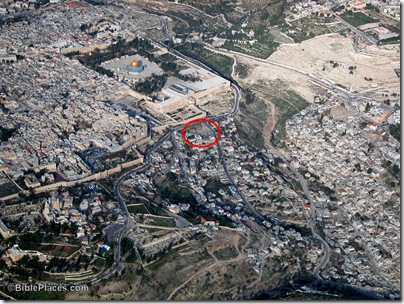
Temple Mount and City of David aerial from sw, tb010703234
Jerusalem from southwest; excavation area circled

That the “City of David was much larger than previously thought” doesn’t make any sense to me. 

The City of David has always been understood to be bordered by the Kidron Valley on the east and the Central Valley on the west and neither of those have moved in the last six months.  Nobody has doubted that there was construction in this area in the 1st century A.D., especially given the Crowfoot expedition in the 1920s.

The “monumental” edifice, which was destroyed by the Romans when they demolished the Second Temple in 70 CE, was dated to the end of the Second Temple Period by pottery and stone vessels, as well as an assortment of coins from that time, Ben-Ami said.

When we were there, we were digging in the Late Roman and Byzantine periods, and I’ve never been part of a dig where we found more coins than this one. 

According to the director of the dig, the elaborate edifice, which is an anomaly in the landscape of the Lower City at the end of the Second Temple period – which was marked with modest buildings – was probably a palace built by Queen Helena, a wealthy Iraqi aristocrat who converted to Judaism and moved to Jerusalem with her sons.

The problem with this statement is that very little digging has been done on the crest of the City of David (as opposed to the eastern slope), and there was much destruction in later periods.  So there isn’t much to compare with.  If all they have is a magnificent building, I’d say it could be Helena’s and it could be someone else’s.

Helena is an interesting individual.  Her tomb in Jerusalem was the second most magnificent one in the ancient world (and it’s still impressive, although difficult to visit because of poor management by the French government; cf. Ant. 20.4.3).  Josephus wrote that Helena built three palaces in the Lower City (one for herself, one for her son and one for her mother-in-law; Wars 4.9.11; 5.6.1), which is (I think) the only basis for the identification of this building as hers by the archaeologist.

Though contemporary with the book of Acts, Helena is not mentioned in the New Testament. 

Josephus connects her with the famine mentioned in Acts 11:28, indicating that she bought large quantities of food from Egypt to feed the people of Jerusalem (Ant. 20.2.3ff.).

The archeologists carrying out the dig have not yet found any inscription to identify the building they uncovered, but the excavation director said that there was a “high probability” that the site was indeed the 2,000-year-old palace of Queen Helena.  “We need more evidence to decide, but almost everything fits,” Ben-Ami said.

This identification could well be, but there’s no evidence for it given in this article.  I would think the identification would be stronger if:

1) more of the City of David had been excavated, thus excluding other sites;

2) we had more knowledge of what else was in the City of David in the 1st century; all we really know is that these palaces were here, but it’s doubtful that these occupied the entire area;

3) finds from the building were of Mesopotamian origin (Adiabene was a province in northern Mesopotamia).

The well-preserved structure being uncovered in the ongoing excavation is an impressive architectural complex that includes massive foundations; walls, some of which are preserved to a height in excess of five meters and built of stones that weigh hundreds of kilograms; halls that are preserved to a height of at least two stories; a basement level that was covered with vaults; remains of polychrome frescoes, water installations and ritual baths.

This is great, but there were many impressive buildings in first century Jerusalem, so this alone is not sufficient to prove the identification.

Those interested in Jewish evangelism and conversion in the New Testament period would find Helena’s story worth studying.  For a start, take a look at the articles in Anchor Bible Dictionary on Proselyte and Circumcision.

Update: The JPost has a one-minute video of the excavations with an archaeologist talking about the discovery.  HT: Joe Lauer.

Update (12/7): InfoLive.tv has a 2-minute video, and this Arutz-7 article has numerous photos which show the well-preserved walls and some of the artifacts discovered.  The story is also covered by Reuters, Haaretz, and the AP.
Share: