Digital imaging technology has virtually opened an ancient scroll from En Gedi to reveal the first two chapters of Leviticus. The publication in Science Advances includes a number of photos. Another article published in Textus is also online. The portions deciphered so far exactly match the Masoretic Text, but the radiocarbon date of 3rd-4th centuries AD differs from the paleographer’s date to the 1st or 2nd centuries.

The discovery of a menorah at Abila provides the first evidence of Jewish presence at this city of the Decapolis.

2,000-year-old human skeleton remains have been found buried at sea near a shipwreck at Antikythera, Greece.

A fisherman’s house from the Ottoman period was discovered along the beach in Ashkelon.

Bedouin youths have helped to excavate Byzantine-era farm buildings in the Negev.

A new virtual reality tour in Jerusalem takes “visitors” inside the Temple. There’s a short video clip here.

Archaeologists plan to finish reconstruction work on Laodicea’s Hellenistic theater within three years.

The Malawi Archaeological Museum in Minya was reopened this week after three years of renovation.

Omar Ghul, an epigrapher at Yarmouk University, discusses important inscriptions discovered in Jordan.

Laïla Nehmé is interviewed by Ancient History Etc. about the history of the Nabateans.

Ferrell Jenkins concludes his series on Iznik (Nicea) with a post on the modern city and its vicinity.

Wayne Stiles considers the history and the lessons from Hezekiah’s Tunnel.

Chris McKinny will be lecturing at Texas A&M Corpus Christi on October 3 on the Late Bronze finds from Tel Burna.

On sale for Kindle for $2.99: Do Historical Matters Matter to Faith?, edited by James K. Hoffmeier and Dennis R. Magary. I require several of the chapters for at least one course I teach.

Mordechai Gichon died this week.

Ferrell Jenkins remembers Erle Verdun Leichty on the announcement of his passing.

HT: Joseph Lauer, Agade, Ted Weis, Charles Savelle
Share:

A stone weight from the first century with the name of the high priest has been discovered in Jerusalem. Ynet has more photos and a video in Hebrew.

Israel’s largest archaeological garden was opened this week on a military base in Tel Aviv.

Archaeologists working at Petra have discovered two statues of Aphrodite.

“Excavations in the volcanic desert of Jordan have uncovered three surprisingly advanced fortified settlements with artificially irrigated terraced gardens, dating to 6,000 years ago.”

Someone is claiming to have discovered one of the stones from the high priest’s breastplate.

“Excavations at Tatarlı Mound in the southern province of Adana’s Ceyhan district have unearthed an impression seal from a monumental Hittite-era structure.”

Aviv and Shmuel Bar-Am provide a virtual tour of the excavations of Ramat Rahel.

Israel’s Good Name describes a recent visit to Chorazin (Korazim) and the first century Galilee boat.

Wayne Stiles suggests that the Transjordanian tribes settled for “second best” and he applies that principle for us today.

Leen Ritmeyer analyzes the paving stone tiles released by the Temple Mount Sifting Project and
suggests they came from “the interior of some of the many buildings that surrounded the Temple and/or from under the colonnades around the smaller courts.”

The Hebrew Music Museum opened earlier this year in Jerusalem and features 260 instruments.

This week Southern Adventist University opened a new exhibit entitled “A World in Miniature:
Creation, Cosmos, and Ecology on Seals from Biblical Times.” The museum’s website does not appear to have information yet on this new display.

The ASOR Blog identifies their five most popular posts of the summer.

The British Institute at Ankara has published nine volumes in the series Roman Roads and Milestones of Asia Minor, all available without charge in pdf format.

HT: Joseph Lauer, Ted Weis, Charles Savelle, Agade

Share:

In excavations on Mount Zion this summer, archaeologists discovered a gold coin with the image of Nero. UNC Charlotte’s press release gives more details:

The discovery of a rare gold coin bearing the image of the Roman Emperor Nero at UNC Charlotte’s archaeological excavations on Mount Zion in Jerusalem has been announced by the archaeologists in charge of the project Shimon Gibson, James Tabor and Rafael Lewis.
“The coin is exceptional, because this is the first time that a coin of this kind has turned up in Jerusalem in a scientific dig. Coins of this type are usually only found in private collections, where we don’t have clear evidence as to place of origin,” said Gibson, an adjunct professor of religious studies at UNC Charlotte.
The gold coin (aureus) bears the bare-headed portrait of the young Nero as Caesar. The lettering around the edge of the coin reads “NERO CAESAR AVG IMP.” On the reverse of the coin is a depiction of an oak wreath containing the letters “EX S C,” with the surrounding inscription “PONTIF MAX TR P III.” Importantly, these inscriptions help to work out the date when the coin was struck as 56/57 AD. Identification of the coin was made by the historian and numismatist David Jacobson from London.
The coin dates to a little more than a decade before the destruction of Jerusalem by the Romans in 70 A.D. and was found in rubble material outside the ruins of the first century Jewish villas the team has been excavating. The team has hypothesized that the large houses may have belonged to wealthy members of the priestly caste, and it may have come from one of their stores of wealth.

The press release includes more information and a photo of the coin. A high-res image of the coin’s obverse is here.

HT: Joseph Lauer

Share:

A stone seal discovered this summer at Abel Beth Maacah suggests Israelite presence at the site in the 9th century.

Luke Chandler has collected a number of photos of floor tiles from Herod’s Temple Mount that have been restored by the Temple Mounting Sifting Project. The Jerusalem Post has more details. There are more photos here. A 20-minute video of the press conference is online, with English starting at about 3 minutes.

Archaeologists have uncovered a Byzantine-era stable at Avdat in southern Israel. High school students joined in the sifting of hundreds of buckets of organic material left behind by donkeys, sheep, and goats. Five high-resolution photos are available.

There’s now an island in the Sea of Galilee. It’s near the southern shore and is the result of the low water level. Artillery shells from WWI have also been discovered nearby.

A mosaic from the Huqoq synagogue may depict Alexander the Great meeting the high priest of Jerusalem. Another interpretation is that it shows the battle between Antiochus VII and John Hyrcanus I. The National Geographic article has photos.

Israel’s ancient capital of Samaria has been vandalized. A video in Hebrew shows some of the damage.

Exploring Bible Lands continues its series on “Walking like Jesus” with a photo of a Roman road in Galilee.

Wayne Stiles explores why Kiriath Jearim is ignored, and why it shouldn’t be.

Thursday’s Archaeological Conference in the City of David entitled “Digging for Truth — Jerusalem,
Archaeology & UNESCO” may be watched online. Parts are in Hebrew and other parts in English, with the whole lasting 4.5 hours. The program may be viewed here. The Jerusalem Post reports on the talk by Dore Gold.

Olive pits discovered at Khirbet Qeiyafa receive special attention at a new exhibit at the Bible Lands
Museum Jerusalem.

HT: Joseph Lauer, Charles Savelle, Agade, Ted Weis

Share:

The National Parks Authority has begun a $750,000 project to restore the Lower Aqueduct between Abu Tor and the Temple Mount in order to open it to visitors for Sukkot.

A stone workshop has been excavated in Galilee between Nazareth and Cana. The archaeologist suggests that perhaps the large stone jars mentioned in John 2 came from a cave like this one.

Archaeologists working in the Hittite capital of Alacahöyük have discovered a secret tunnel.

An article in Haaretz highlights similarities of Philistine culture to Cypriot cities and technology, supporting the theory of their Aegean origins.

A collection of metal artifacts discovered near the coast of Caesarea over several decades has been turned over to the Israel Antiquities Authority.

Seventy percent of the work on the archaeological park around the Giza pyramids is complete and the plan is to open it by the end of the year.

The BBC asks, “Will the skyscrapers outlast the pyramids?

The tomb of Suleiman the Magnificent is being excavated in a small town in Hungary.

New book: The Archaeology and History of the Church of the Redeemer and the Muristan in Jerusalem, edited by Dieter Vieweger and Shimon Gibson. Publication details here.

Wayne Stiles has a very good deal going right now on the audiobook version of his excellent Waiting on God.

HT: Agade, Joseph Lauer, Charles Savelle

Share:

A high school student found a ballista ball from the Bar Kochba Revolt during recent excavations of Beitar.

Excavators working at Abel Beth Maacah discovered one of the earliest silver hoards ever found.

There’s more information about the excavation of the chariot race mosaic in Cyprus.

To make the looting of Syrian artifacts more difficult, the US State Department announced emergency import restrictions.

“Oxford University researchers say that trees which grew during intense radiation bursts in the past have ‘time-markers’ in their tree-rings that could help archaeologists date events from thousands of years ago.”

Wayne Stiles explains how the Herodium testifies to God’s sovereignty.


The New York Times is no fan of the Ben-Hur remake.

The Associates for Biblical Research are beginning to recruit for their first season of excavations at Shiloh next summer.

Leon Mauldin posts on the end of wicked Queen Athaliah and shares a photo of a model of Jerusalem at the Bible Lands Museum.

If you wanted to know a little more about Enoch’s journey through the world (referenced in
Thursday’s survey results), Paleojudaica explains.

The new NIV Cultural Backgrounds Study Bible is being released on Tuesday. It looks impressive, and you can flip through the entire books of Genesis and Matthew online to see for yourself.

Hundreds of photos, maps, and charts accompany study notes edited by John Walton (OT) and Craig
Keener (NT). The promotional website also includes videos and infographics.

HT: Agade, Ted Weis, Joseph Lauer

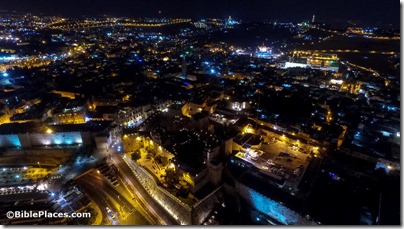
Old City aerial at night from southwest, ws052016101
Our most re-tweeted photo of the week was this aerial photo taken by Bill Schlegel of Jerusalem from the southwest. The Citadel of David is in the foreground and the Mount of Olives is in the distance.
Share: