A winepress from the Byzantine period was discovered at Chorazin by a team doing conservation work.

The recent discovery of a depiction of the Egyptian god Bes in the City of David Givati parking lot excavation is the first of its kind ever found in Jerusalem.

The Times of Israel features a well-illustrated story on the Beth Shemesh excavations including the controversy and the museum exhibit.

A new sound-and-light show, used advanced technologies, has been unveiled at Masada.

A shipwreck discovered in Heracleion matches the description of a Nile River boat described by Herodotus.

Excavation work at Macherus is complete after 11 years, but conservation work will continue.

Over a million people are expected between March-September to attend the Louvre exhibition of the  Egyptian pharaoh Tutankhamun. The show features the largest number of Tut items ever displayed together. As construction nears completion for the new Grand Egyptian Museum in Giza, the Egyptian Ministry for Antiquities states that after the six city world tour is completed, key pieces related to Tut will never again leave Egypt.

The Basrah Museum in southern Iraq has added three new galleries, totaling 2,000 pieces, focused on Sumer, Assyrian, and Babylonian objects.

Erin Darby will be lecturing on “The Archaeology of Women in Ancient Israel” in Oak Ridge, Tennessee, on April 2.

The History Channel has a photo essay of ten biblical sites.

Wayne Stiles recently visited the Royal Mummies Hall in the Cairo Museum.

Bible History Daily features a profile on Julia Berenice, the companion of King Agrippa II in Acts 26.

New from the Oriental Institute of the University of Chicago: The Great Hypostyle Hall in the Temple of Amun at Karnak, by Peter J. Brand, Rosa Erika Feleg, and William J. Murnane. For purchase in hardback or a free download.

“The Setting of the Assassination of King Joash of Judah: Biblical and Archaeological Evidence for Identifying the House of Millo,” by Chris McKinny, Aharon Tavger, Nahshon Szanton, and Joe Uziel, is a paper read and illustrated by Chris McKinny.

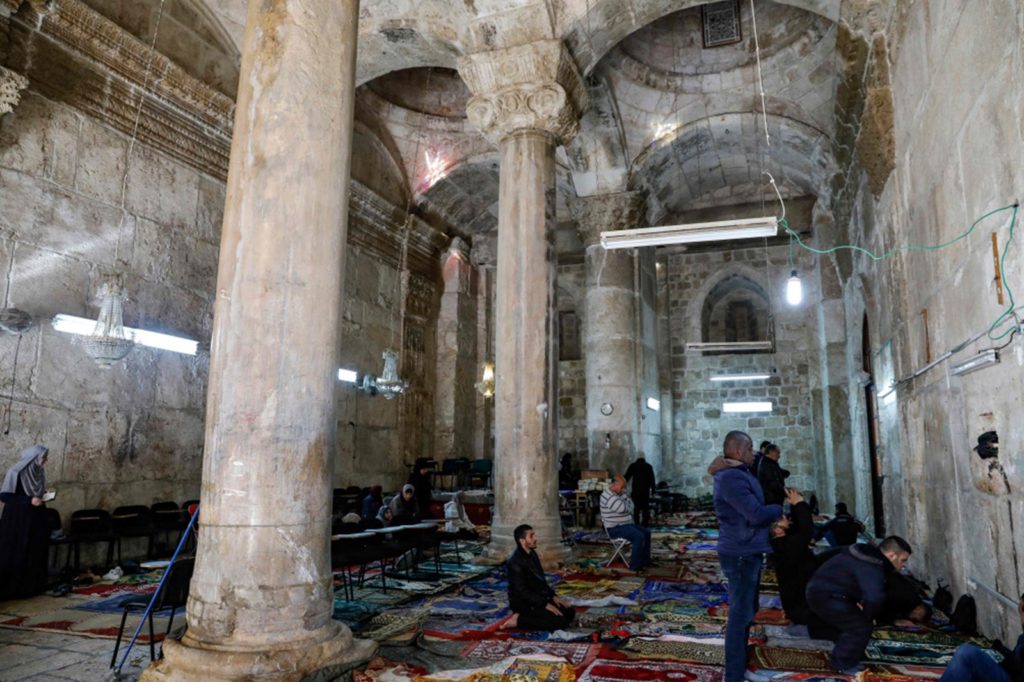
The photo below, from DerStandard, shows the interior of the Golden Gate in recent times.

HT: Ted Weis, Agade, Charles Savelle, Alexander Schick, Paleojudaica

Interior of the Golden Gate
Photo from DerStandard

An attempt to smuggle into Britain an ancient Babylonian kudurru as a “carved stone for home decoration” with a value of “300” failed.

“Music was ubiquitous in Ancient Greece. Now we can hear how it actually sounded.”

Israel has become the first country to list all cemetery tombstones online.

The February 2019 issue of the Newsletter of the Egyptian Ministry of Antiquities includes the latest discoveries, repatriations, and news.

A Greek archaeologist has been working in Alexandria for 15 years in an effort to find the tomb of Alexander the Great.

A 3-minute video shows an animation of what the hanging gardens of Babylon may have looked like.

The Museum of the Bible is hosting a two-session lecture series on “Jerusalem and Rome: Cultures in Context in the First Century CE,” featuring Eric Meyers, Mary Boatwright, Lawrence Schiffman, and Steven Notley.

Eric Meyers will be lecturing on March 28 in Chapel Hill, North Carolina, on “Holy Land Archaeology: Where the Past Meets the Present.”

Six speakers will address the subject of “Egypt and Ancient Israel: Merneptah’s Canaanite Campaign—History of Propaganda?” in a conference at Southwestern Baptist Theological Seminary on March
26.

Chris McKinny’s recent lecture on “Tel Burna—After a Decade of Investigation” is now online. The video includes all of his visuals.

This is fascinating: Predators in the Thickets: A Film Interview with Two Botanists and a Zoologist in Israel. You’ll learn more about lions, bears, forests, thickets, the Zor, and the Ghor. The film is intended an introduction to the newly launched Dictionary of Nature Imagery of the Bible.

Amos Kloner died yesterday.

HT: Agade, Chris McKinny, Joseph Lauer

New clues to the lost tomb of Alexander the Great are being unearthed in Egypt (National Geographic).

Sinai’s 500 plus photographic entries from mid 19th to mid 20th centuries . . . are now published online with detailed geography and history description . . . based on the 19-year field survey and maps of Sinai Peninsula Research (SPR).”

Erin Blakemore recounts the tale of how a modern attempt to play King Tut’s trumpets went awry.

Somehow John DeLancey is able to post summaries every day for his tours, including their recent days in Egypt.

Iraq is seeking World Heritage List status for the ancient city of Babylon.

Tourists are apparently returning to the ancient city of Ur in southern Iraq.

Esagil, Treasure Hunt in Babylon, is a a board game with a real-scale map of ancient Babylon.

The opening of a spectacular ancient Jewish catacomb in Rome continues to be delayed.

What is “biblical archaeology”? Owen Jarus provides some definitions and an introduction to some of the controversy surrounding its use.


Smithsonian Magazine profiles Wendell Phillips, sometimes known as America’s “Lawrence of Arabia.”

The majority, or perhaps even all, of the 75 new “Dead Sea Scrolls” fragments that have appeared on the market since 2002 are modern forgeries, according to Årstein Justnes and Josephine Munch Rasmussen. UPDATE: I am told by someone I trust that this article has many errors, including in its basic assertions.

ASOR has begun its March Fellowship Madness 2019 to raise funds to help students and scholars.

Ferrell Jenkins explains why he is fond of an “unattractive” photo taken at the Corinth Museum.

Two new videos with Aaron Brody: Introduction to the Bade Museum and Repatriating Antiquities.

HT: Ted Weis, Agade, G. M. Grena

IMG_20190301_134514_thumb[1]
Destroyed baptismal site on the Jordan River after recent flooding
(Photo by Alexander Schick)

Researchers have constructed kilns to determine how iron was smelted in ancient Israel. (Haaretz premium)

New research has identified where refugees fleeing Mount Vesuvius’s eruption later settled.

The New York Metropolitan Museum of Art will return a recently purchased gold-gilded Egyptian coffin that turned out to be looted.

$55 million will be invested to renovate several sites in the Jewish Quarter of Jerusalem’s Old City, including the Burnt House, the Wohl Archaeological Museum, and the Tiferet Yisrael Synagogue.

A new museum will join the complex of tourist attractions at Latrun, this one honoring Jews who fought in WWII.

The Madaba Plains Project is celebrating 50 years of archaeological work in central Jordan.

Cyrene, Leptis Magna, and other antiquities sites in Libya are being neglected and vandalized since the fall of Gaddafi.

“Israel is hundreds of years overdue for a massive earthquake,” writes Ruth Schuster (Haaretz premium).

Sebastian Fink explains the significance of salt in ancient Mesopotamia.

Wayne Stiles: “The Judean Wilderness illustrates the greener grass we envy.”

Ferrell’s photo of the week is of the Appian Way that Paul traveled as he approached Rome.

Mark Barnes explains why Jesus was baptized in the Jordan River, with reference to the ministries of Elijah and Elisha.

Kings of Israel is a board game taking place in Israel (the Northern Kingdom) during the reign of its kings up until Israel’s destruction by Assyria. Players are on a team, with each person representing a line of prophets…” BibleX has a list of other Christian board games.

The Institute of Biblical Culture’s new course in March, “Daily Life in Ancient Israel,” will cover topics like agriculture, the calendar, tribalism, and lifecycles.

The topic of the Tyndale House Conference 2019 is “Exploring the Old Testament and Its World.”

HT: Agade, Ted Weis

A tomb containing 50 mummies from the Ptolemaic era has been discovered in Minya, south of Cairo.

The latest documentary produced by Bible Passages is “The Power of Jesus in Galilee.” The 22-minute video was filmed on location.

The world’s first film in the Babylonian language has been released.

The latest video from the British Museum explains an Assyrian relief that depicts a battle with Elam.

In an 8-minute video, Luke Chandler explains Sennacherib’s invasion of Judah using the reliefs in the British Museum.

Carl Rasmussen is leading a tour that follows in the footsteps of Paul from his shipwreck on Malta to his martyrdom in Rome.

Now is the time to sign up for a summer excavation in Israel, including at Gath.

Lamia Al-Gailani Werr, one of Iraq’s first female archaeologists, died recently.

HT: Agade, Steven Anderson, Ted Weis

The AFP was given a private tour of the “Tomb of the Kings” in Jerusalem, while discussions are ongoing with the French government on re-opening the site to the public.

Renovations of a shop in Paris revealed a large hidden painting of the city of Jerusalem.

The greatest threats to archaeology in Iraq are looting and uncontrolled building.

Carl Rasmussen shares photos of a procession of the Roman elite at Ephesus.

Wayne Stiles looks at three reminders that come from Jesus’s ministry in Galilee.

Evan McDuff describes his experience in excavating Tel Dor.

Graham Chandler provides an interesting and well-illustrated look at ivory in the ancient Near East.

The latest episodes on Digging for Truth look at the relationship between ancient child sacrifice and modern abortion (part 1, part 2, part 3).

Scattered Finds: Archaeology, Egyptology and Museums, by Alice Stevenson, is now available in print or as a free pdf.

Bryan Windle has created two top ten lists:

HT: Agade, Joseph Lauer, Steven Anderson