The Bornblum Eretz Israel Synagogues Website is a new work that presents “bibliographical references, geographical location, photos, plans and brief descriptions of excavated ancient synagogues from the Roman and Byzantine periods in the Land of Israel.”

A four-minute newscast reports on new excavations in the Timna Valley and its copper mines.

Four individuals are in trouble after a video of them breaking off pieces of the Giza pyramids went viral.

“The Aleppo Codex, on permanent display at the Israel Museum in Jerusalem, has been declared a world treasure by UNESCO.”

A group of artifacts from the Museum of the Bible Collection is now on display in Cuba.

“The Extraordinary Gertrude Bell exhibition will be at the Great North Museum in Newcastle until May 3.”

Jodi Magness will be lecturing on “Samson in Stone: New Discoveries in the Ancient Synagogue at Huqoq in Israel’s Galilee” on February 15 at UNC. She will be giving the same lecture at the Getty Villa on April 3.

Birger Ekornåsvåg Helgestad and Jonathan Taylor will be lecturing in London on February 24 on

“Walking in Woolley’s Footsteps: Ur Brought to Life for the Digital Age.” Registration is required.

“In the Valley of David and Goliath: Digging Up Evidence on the United Monarchy” symposium will be held in New York City on March 30.

Applications are now being accepted for the Cyprus Underwater Archaeology Field School 2016.

A one-week Field School on Archaeological Science in Ancient Corinth will be held June 6 to 11.

HT: Agade, Joseph Lauer, Charles Savelle

Share:

A Jerusalem Post article by the chairs of the PEF and the Early Exploration of the Holy Land conference describes some of the Temple Mount explorations by Charles Warren.

After a major sandstorm last week, Israel is gearing up for a mega-snowstorm this week.

A major archaeological campaign to ancient sites in southern Israel has led to big questions: Why did the people abandon the sites? Why were these desert-dwellers eating large quantities of fish? And where are the Nabatean remains in these so-called Nabatean cities?

The oldest Christian monastery in Iraq, St. Elijah’s Monastery, has been destroyed by ISIS.

A new exhibit, “Khirbet el-Maqatir: History of a Biblical Site,” is opening in February at Faulkner University’s Kearley Graduate School of Theology.

Newsweek takes a look at new technology being used to read ancient scrolls.

“An international team of researchers said Sunday they will soon begin analyzing cosmic particles collected inside Egypt’s Bent Pyramid to search for clues as to how it was built and learn more about the 4,600-year-old structure.”

A couple of items of note from the Caspari Center Media Review:

”This article protests the planning of a housing project on the southern slope of Karnei Hittin, as it is not only the location of famous battles such as the Crusader defeat by Saladin in 1187, but also one of the possible locations of the Mount of Beatitudes.”

“This article recounts a number of recently published tourism statistics for 2015. Of particular note is the fact that 52% of incoming tourists were Christian, with 22% declaring that they had come for pilgrimage. The average rate of satisfaction was 4.4 out of 5.”

Tree historian Yaacov Shkolnik identifies the four most interesting trees in the Tel Aviv area.

HT: Charles Savelle, Joseph Lauer, Ted Weis

Share:

Have archaeologists identified some of the pilgrimage roads that led up to Jerusalem?

The Dead Sea is a fascinating place, as Wayne Stiles shows from his research and with some good visual aids.

@PalExFund shares a great photo from 1903 of the “PEF Observation Rock” along the shore of the Dead Sea.

Though the winter season at Khirbet el-Maqatir was cancelled, Scott Stripling led a small group to Israel and he shares his diary of the places they saw and the friends they met.

You can listen to part 2 of my discussion with Gordon Govier of 2016 excavations as well as other recent programs at The Book and the Spade.

Shmuel Browns shares some beautiful photos from Makhtesh Gadol. And he is co-leading the Great Makhtesh Photograph Adventure next month.

ABR is introducing a new archaeology curriculum for children.

Test your knowledge of Jericho with a new quiz at the ASOR Blog.

Eisenbrauns has a sale on Israel Exploration Society publications for 30 to 50% off.

Ken Dark concludes that satellite imagery is less useful for discovering new features around the Sea of Galilee than fieldwalking and surface surveys.

Leen Ritmeyer notes that Jerusalem the IMAX movie is currently available for free on Youtube.

Threshing floor in Jerusalem, Sheikh Jarrah, with Ambassador Hotel, mat23102
Threshing floor in Jerusalem near the Ambassador Hotel, 1953
Source: Library of Congress, LC-matpc-23102/www.LifeintheHolyLand.com
Share:

Archaeologists have found another ancient olive press at Shiloh.

The oldest known artifact of smelted lead has been discovered in a burial cave in the Negev.

George Athas provides some analysis of the Hezekiah seal impression.

Hoards: The Hidden History of Ancient Britain,” an exhibit at the British Museum, illustrates the action of the parable in Matthew 13:44.

HaDavar Biblical Museum is now under construction in Hong Kong.

The Associates for Biblical Research have cancelled their Winter Dig for this year and are considering postponing next summer’s excavation.

PEF and the Early Exploration of the Holy Land is the title of a conference being held at the University of Haifa in December.

The Mount Carmel forest fire led to the discovery of a farming community from the first century.
‘Atiqot 83 is now online.

Wayne Stiles explains the providential irony in the discovery of the Tel Dan Inscription.

The government is appealing the transfer of the Davidson Center Archaeological Park to management by Elad.

ASOR will be posting some of the presentations from the Annual Meeting on their website.

Andy Naselli recommends the Jerusalem IMAX movie, now on DVD. I agree.

CBD is running a big sale on Craig Keener’s 4-volume commentary on Acts through Monday ($138; Amazon: $192).

A free (pdf) book from HCSB: Exalting Jesus in Exodus (requires email address).

Logos Bible Software is also giving away a free book a day during Advent.

Happy Hanukkah!

HT: Agade, Charles Savelle

Share:
by Chris McKinny

Many visitors to Israel have visited the Nahal Zin and hiked into Ein Avdat. While witnessing the canyon’s spectacular views and wildlife, visitors will probably be informed that Nahal Zin was the southern border of the promised land (and thereby Canaan and the tribe of Judah) based on a connection between the large, continuous canyon (Arabic – Wadi el-Marra) and the southern boundary descriptions in the Bible (Num. 34:4; Josh. 15:3).
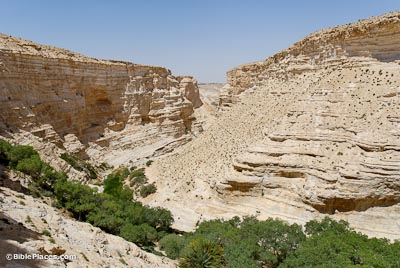
Ein Avdat – BiblePlaces.com

The identification of Wadi el-Marra with part of the Wilderness of Zin seems to be very plausible, even if the name “Nahal Zin” is a modern construction. Essentially, the identification of Wadi el-Marra with the southern boundary is based on the following two pieces of evidence: 1.) Wadi el-Marra is the only natural topographic boundary in the region and 2.) it is located between the Ascent of Akkrabim and Kadesh-barnea (Ein el-Qudeirat), which fits the biblical description. However, there is an additional piece of evidence that seems to make this identification even more secure – the location of Mount Halak at Jebel Halaq. Update – see here for Musil’s description of Jebel Halaq (German).

Southern Boundary Markers of Canaan/Judah on Karte Von Arabia Petraea (A. Musil 1906)

This identification was made over a century ago by Alois Musil in his Karte Von Arabia Petraea who was told that the northern cliff face of Wadi el-Marra (i.e. Nahal Zin) was called Jebel Halaq by the local population. Since “jebel” means “mountain” in Arabic and the second part of the name is identical to the biblical place name, this identification was generally accepted. However, since the early cartographic projects did not cover the Negev Highlands (e.g., the Survey of Western Palestine, Van De Velde’s Map) most are unaware of this connection and its implications for biblical geography. Mount Halak is mentioned twice in the book of Joshua, in both cases it is within a north-south boundary description describing the territory that Joshua conquered.

“So Joshua took all that land, the hill country and all the Negeb and all the land of Goshen and the lowland and the Arabah and the hill country of Israel and its lowland from Mount Halak, which rises toward Seir, as far as Baal-gad in the Valley of Lebanon below Mount Hermon. And he captured all their kings and struck them and put them to death. Joshua made war a long time with all those kings.” (Josh. 11:16–18 ESV) 

“And these are the kings of the land whom Joshua and the people of Israel defeated on the west side of the Jordan, from Baal-gad in the Valley of Lebanon to Mount Halak, that rises toward Seir” (Joshua 12:7 ESV)

Aerial view of Nahal Zin with view of Mount Halak (Jebel Halaq), photo by Bill Schlegel

Jebel Halaq faces towards southern Jordan and the mountains of Edom (i.e. Mt. Seir), which matches the passages from Joshua. When we add Mount Halak (Jebel Halaq) to the accepted identifications of Tamar (En-Hazeva), the Ascent of Akkrabim (Roman road west of Tamar rising to Mamshit), and Kadesh-barnea (Ein el-Qudeirat), it is clear that the various boundary descriptions were describing the same border, which they demarcated using various topographical features (oases, mountains, and natural roads). 

For those who visit the Nahal Zin/Ein Avdat, Mount Halak (Jebel Halaq) can be seen either on the bus ride down to the hike or at the Ben-Gurion tomb, which overlooks the Nahal Zin. Be sure to look that way next time you make it down there!
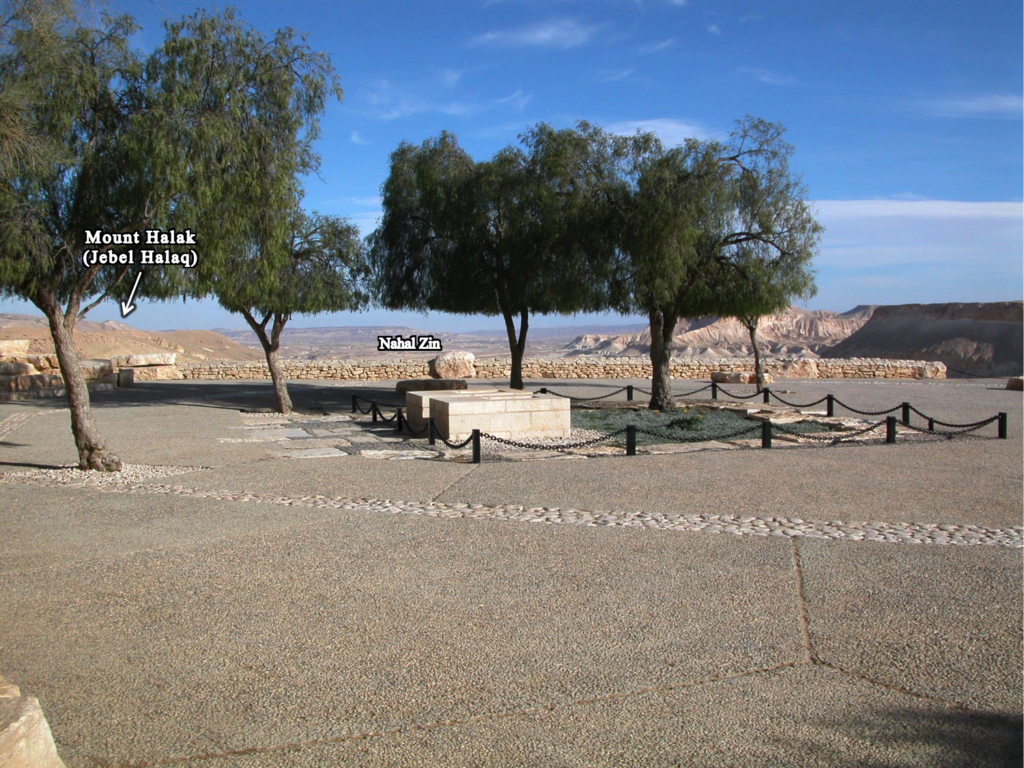
Ben-Gurion tombs with Nahal Zin and Mount Halak in background
Share:

This week’s sandstorm in Israel is the worst it has experienced since the nation was founded in 1948.

Air pollution in Jerusalem was 173 times higher than average. Carl Rasmussen shares a video showing how bad it was on the Mount of Olives.

What exactly is a 100-foot-deep shaft doing next to the Rockefeller Archaeological Museum in Jerusalem?

Andrew Bernhard posts on the End of the Gospel of Jesus’ Wife Forgery Debate.

Thieves in Galilee were caught removing a sixth century mosaic church floor in Gush Tefen.

The cisterns at Arad are now open to visitors.

Muslim “sentinels” protecting the Temple Mount from “sacrilege” have now been outlawed by Israeli police.

If your interest is in exotic shofars and what Jewish halakah has to say about it, Zoo Torah has a free pdf on the subject.

The BBC reports on six “lesser-known wonders of the ancient world,” including the site of Baalbek in Lebanon.

The Jerusalem Post Magazine reports on sinkholes around the Dead Sea. (At the moment of posting this, the link is not working. Perhaps it will return.)

ISIS is destroying ancient buildings in order to conceal evidence that they are looting for profit.

The Institute for Digital Archaeology plans to distribute 10,000 3-D cameras in the coming year in
order to document archaeological sites and objects in West Asia before they are destroyed.

A luncheon will honor James F. Strange at this ASOR meeting in Atlanta.

Ferrell Jenkins illustrates what David meant when he wrote about “a dry and weary land where there is no water.”

Did you know that the Upper Room is located directly above David’s Tomb?

The Dead Sea Scrolls scam at the California Science Center closed this week.

“The Manar al-Athar open-access photo-archive (based at the University of Oxford) aims to provide high resolution, searchable images, freely-downloadable for teaching, research, heritage projects, and publication. It covers buildings and art in the areas of the former Roman empire which later came under Islamic rule (e.g. Syro-Palestine/the Levant, Arabia, Egypt, and North Africa), from ca. 300 BC to the present, but especially Roman, late antique, and early Islamic art, architecture, and sacred sites.”

HT: Charles Savelle, Ted Weis, Agade, Joseph Lauer, Jared Clark

Our Facebook photo with the most clicks in the past week was the final one in our “holy rocks” series.

Gezer standing stones, bowing down, tb091405098
Standing stones at Gezer
Share: