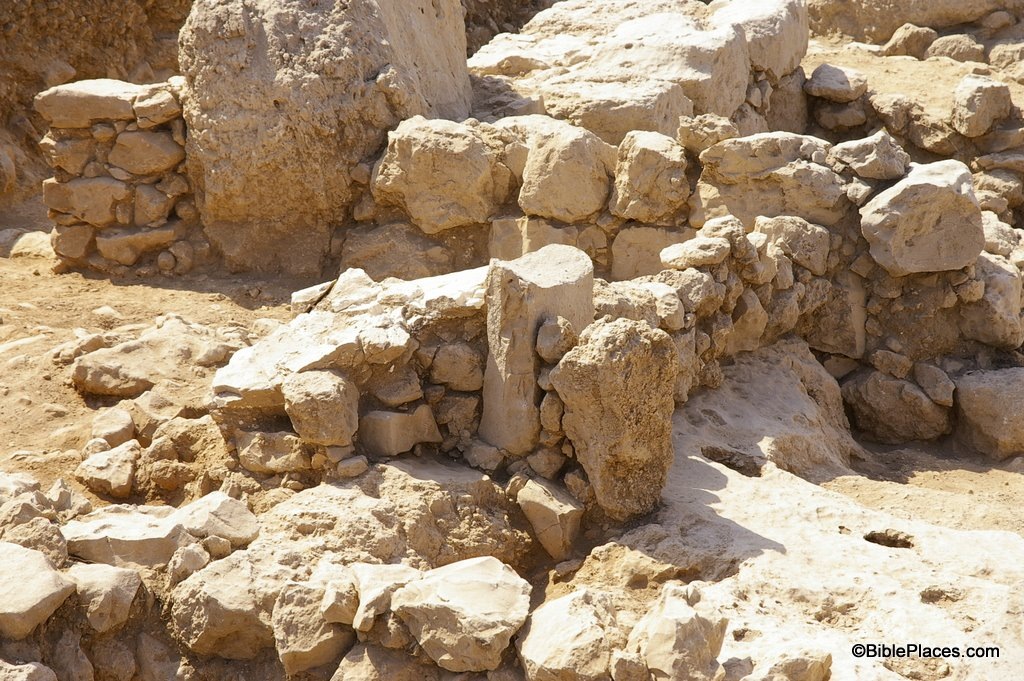
The San Francisco Chronicle is reporting that excavator Yosi Garfinkel believes Khirbet Qeiyafa is Shaaraim (Shaarayim), and this is confirmed by David Willner on the excavation website. This suggestion does not need to deny the David and Goliath story to find support (as does the Gob identification). Garfinkel will make a presentation (or two) this week about the site, but from what has been revealed thus far, there are two bases for his conclusion. 1) Shaaraim is mentioned in the story of David and Goliath (1 Sam 17:52). 2) Garfinkel found a second gate at the site last week. This is suggestive because the name “Shaaraim” means “two gates.”

This portion of the article is worth quoting:

Garfinkel, who has excavated numerous sites in Israel, says he discovered the second gate after noticing an apparent break in the massive stone wall as he walked along the 2,100-foot long structure that faced the road to Jerusalem. After two days of digging, his hunch paid off. A second entrance constructed from massive stones lay just a few feet beneath the topsoil.
“This is the only city from the Iron Age in this region ever found with two gates,” said Garfinkel as he clambered over the huge structure. “It was probably a mistake. It made the city more vulnerable. It might explain why it appears to have been settled only twice, for very short periods.”
Garfinkel says he is certain the newly-found massive stone gate was the main entrance to the city that existed at the beginning of the 10th century B.C. and then again for a few years at the time of Alexander the Great.
“It is enormous, it has symbolic value demonstrating authority and the power of the kingdom,” Garfinkel said while describing the huge building blocks of more than 3 feet square and 10 feet long, each weighing more than 10 tons. “They are the largest ever found from the Iron Age. If King David ever came here from Jerusalem, he entered from this gate. It is likely we are walking in the footsteps of King David.”
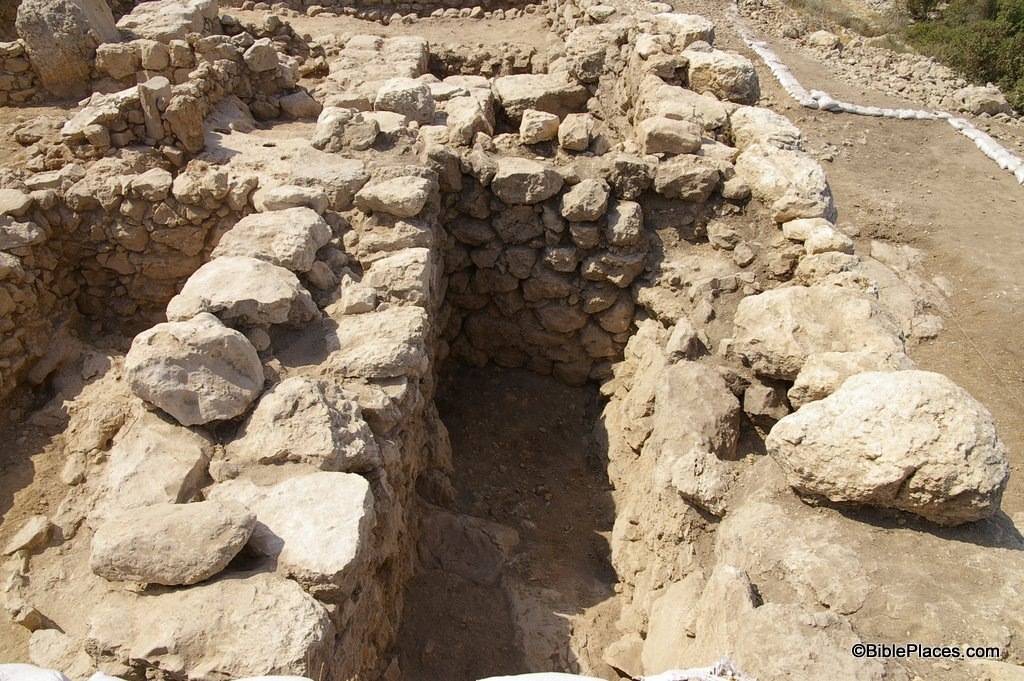
Khirbet Qeiyafa, 10th c casemate wall, ar080731445 Casemate wall at Khirbet Qeiyafa, 10th century B.C.

This is very significant, for not only are there very few early 10th-century fortifications in Israel, I don’t know of any with two gates. There are, however, some potential problems. 1) Apparently only a few days have been spent in excavation of this second gate, which would suggest that caution in conclusions at this point is wise. 2) Who built this massive gate? If it dates to the early 10th century, then one might connect it with David’s kingdom. But if that is so, then it was not the scene of his pre-kingship battle with Goliath. Perhaps, then, it was built by King Saul. The problem with that is that scholars don’t believe he had any real power. 3) Why were two gates built? Did someone who went to all the work in moving stones weighing more than 10 tons really not think through the problem of having two gates? I have trouble believing that we today understand their warfare better than they did.

There are some other potential problems with this identification. The only other place where Shaaraim is mentioned in the Bible is in a list of cities of Judah.

Joshua 15:33-36 (NASB) In the lowland: Eshtaol and Zorah and Ashnah, 34 and Zanoah and En-gannim, Tappuah and Enam, 35 Jarmuth and Adullam, Socoh and Azekah, 36 and Shaaraim and Adithaim and Gederah and Gederothaim; fourteen cities with their villages.

This text proceeds roughly from north to south (Sorek Valley, then Elah Valley). The sites in the Elah Valley appear to proceed from east to west: Adullam, Socoh, Azekah. If so, this suggests that Shaaraim would be located west of Azekah. If Shaaraim was Qeiyafa, it would logically fit between Socoh and Azekah.

This location (west of Azekah) seems to be supported by the David and Goliath account. Shaaraim is mentioned only at the end of the story. The Philistines fled west from the battle to Gath and Ekron, dying on the way of Shaaraim.

1 Samuel 17:52 (NASB) The men of Israel and Judah arose and shouted and pursued the Philistines as far as the valley [or Gath], and to the gates of Ekron. And the slain Philistines lay along the way to Shaaraim, even to Gath and Ekron.

Normally, this construction “way of [place]” means the road to a certain place (e.g., 1 Sam 13:17-18; 2 Sam 2:24; for a myriad of examples, see Dorsey, Roads and Highways of Ancient Israel, 47-50, where he finds only one road in the Bible not named after its destination, Num 20:17). It is difficult to conceive of a battle scenario where the road they are fleeing on would be called the “way of Shaaraim” if Shaaraim = Qeiyafa. 1) If the Philistines were encamped on the south side of the valley and the Israelites were encamped on the north side near Qeiyafa, why would the Philistines flee on the “way of Shaaraim”? 2) If the battle was much farther to the east, and the Israelites were encamped in the lower slopes of the hill country and the Philistines were encamped on the eastern end of the Elah Valley, a) one wonders why it was called the way of Shaaraim and not the way of Azekah, the bigger and more well-known city nearby and b) one cannot account for the Philistines being encamped “between Azekah and Socoh.” In short, Shaaraim is best located on the far (eastern, northern, or southern) side of Azekah, and not on the side closer to the battlefield. This also makes sense of the following phrase “the way of Shaaraim as far as Gath and Ekron.”

John Hobbins interacts with Garfinkel’s proposal of Shaaraim. I agree with him on point #1 but do not think he goes far enough (as I have above). I disagree on point #2, as it seems that if the Philistines are fleeing towards Shaaraim, then this would likely be in their territory. To say it another way, if Qeiyafa = Shaaraim, we should expect it to be a Philistine site (at least at the time of the battle). Garfinkel’s evidence suggests that Qeiyafa is an Israelite site.

This does not address the reality of “two gates” at Qeiyafa. If we are certain that both were in use at the same time, and we know that there are no other sites in the area that had two gates, this would be strong evidence. I don’t know how certain the excavators are that the two gates are contemporaneous.
I’m very hesitant to say that there are no other sites with two gates, since until a week ago, even Qeiyafa was not known to have two.

By way of conclusion: If Qeiyafa is Shaaraim, either 1) the Israelites were encamped here at the time of the battle of David and Goliath or 2) the Philistines were not encamped between Azekah and Socoh or 3) Shaaraim = Ephes-dammim. Of the three, I find #1 to be most likely, but it then is strange that a) Shaaraim is not mentioned as the place of Israel’s encampment and b) the Philistines are said to have fled on the way of this Israelite site. From the Philistine perspective, the road from Gath to the east might be called the “way of Shaaraim” (though it requires ignoring Azekah), but the biblical record was not written from the Philistine perspective.

Neither this post, nor the previous one, furthers my suggestion that Qeiyafa is Ephes-dammim. But they do, I believe, make the identifications with Gob and Shaaraim less attractive. Everyone in the discussion is working with a fraction of the total evidence. Garfinkel, as excavator, has more of the evidence available to him, but it is not difficult to imagine future discoveries that significantly clarify or alter the picture. To that end, we wish the excavators great success in their on-going work.
Share:

Nadav Na’aman has written an article (pdf) in the Journal of Hebrew Scriptures suggesting that Kh. Qeiyafa is Gob.  Na’aman begins with the conclusion that Qeiyafa is a Philistine site.  He does this by dismissing three lines of evidence from the excavators (pottery, absence of pig bones, Hebrew inscription).  I am unconvinced by this part of the discussion, but I don’t think it undermines the rest of his presentation.

The next paragraph is of most interest to me, as I previously suggested that Qeiyafa be identified with Ephes-dammim.  Let’s follow Na’aman’s line of reasoning.  It’s important to note that his cursory dismissal allows him to move to a more radical proposal.  His text is in bold and my comments are in brackets.

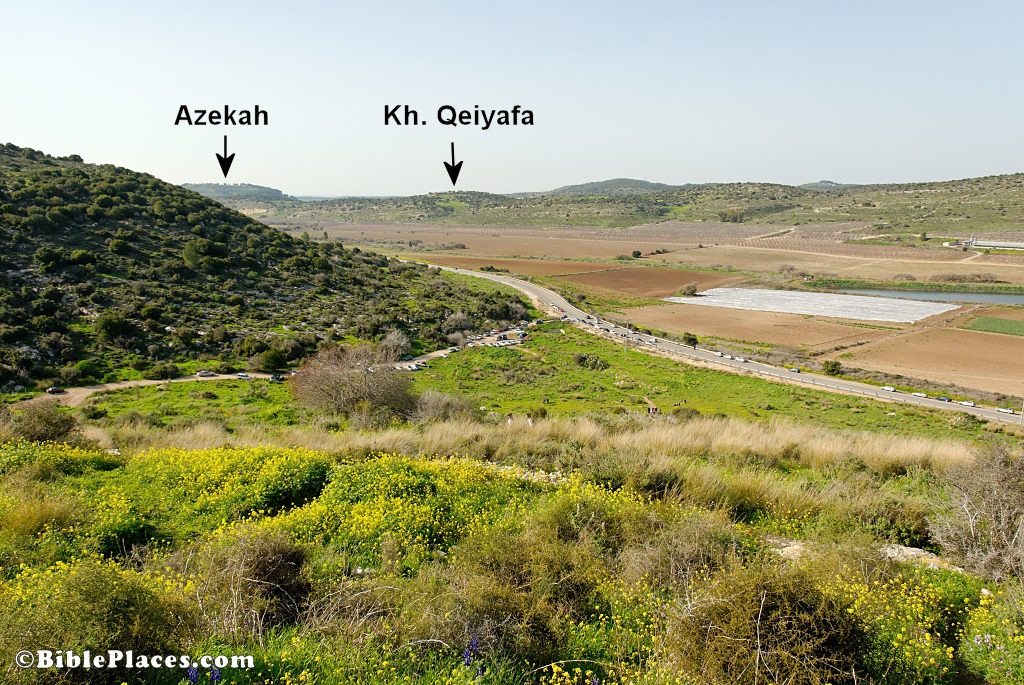
The description [of 1 Sam 17:1-2] indicates that the story was written after the consolidation of the kingdom of Judah, when Socoh (and Azekah) were Judahite cities. [He presupposes, contrary to the biblical account, that Judah was only formed many years after the time of David.] According to the description, the Philistines encamped south of the Elah Valley, where Ephes-dammim must be sought, and Saul and his army arrived from the northeast and encamped north of the valley. [Read 1 Sam 17:1-2 again.  It says nothing about the Philistines being “south.”  Perhaps it was (and I have believed for many years that it was), but it only says that Ephes-dammim is between Azekah and Socoh, and as my photos here show, Qeiyafa is both between the two sites and north of the Elah Valley.] Although the Israelite army encamped not far from Khirbet Qeiyafa, this important stronghold is not mentioned in the story. [Whoa, see how he did that?  He just jumped right over the possibility that Qeiyafa is Ephes-dammim, because it “must” be on the south side.] Evidently, the site was destroyed and deserted at the time when the story was written. [This is typical of Na’aman’s work: one possibility, however unlikely, becomes the foundation for another possibility, which then becomes certainty, and the foundation for a larger theory (see the rest of the article).  But if you pull out one card, the house comes falling down.  Since his creative theory developed in the rest of the article requires precluding Qeiyafa from being Ephes-dammim, he must not allow this very real possibility to detain him.]

Elah Valley and Azekah view nw from Socoh, tb021707830

View from Socoh looking west towards Azekah

Na’aman then proceeds to 2 Samuel 21:19, and he concludes that the David and Goliath story (1 Sam 17) is a later and much embellished (and distorted) retelling of the former.  He does not seem to recognize the following weaknesses with his theory: 1) the victors in the two stories have different names; 2) the fathers of the victors in the two stories have different names; 3) the location of the battles are given in each account, but there is no similarity between the two; 4) the context of the two battles in the larger biblical narrative is unrelated; 5) 1 Chronicles 20:5 gives a parallel account of 2 Sam 21:19. 

If you’re going to continue with Na’aman, you have to accept that 1) the highly detailed account of David vs. Goliath is pure fiction based upon a historic “kernel” that bore no relation to it; 2) the author of Samuel was ignorant (or unconcerned) that he was including the same “story” twice – both the kernel and the later embellishment. 

A better approach is to recognize the close similarities between 2 Sam 21:19 and 1 Chron 20:5 and acknowledge that these are the same story, but 1 Sam 17 is a different event.  There are textual difficulties in the two brief accounts, but you can’t explain David out of the Goliath story of 1 Sam 17 by scribal errors.  Instead you have to believe in deliberate deception and/or incredible ignorance. 

(Much of the scholarly approach to the OT is predicated on these two principles: most ancients were stupid, and the few brilliant ones were liars, albeit espousing the worship of a highly ethical God.)

I do not, however, think that a rejection of Na’aman’s proposals to this point necessarily disqualifies his identification of Qeiyafa as Gob.  2 Samuel 21:18-19 mention two battles with the Philistines, and since 1) Qeiyafa is a logical place of conflict between Israelites and Philistines and 2) Gob has not yet been identified, I think it is a plausible idea.  I just think that Na’aman has much less evidence to support it than he thinks he does.

John Hobbins has written a lengthy analysis of Na’aman’s article.  He makes some good points against the identification of Qeiyafa as a Philistine site.  One problem, as I see it, is that we should not assume that the situation was static in this period of Israel’s history.  Quite possibly, sites changed hands.  In fact, that seems to be what is at stake in the narrative of David and Goliath.  The Shephelah was the contestable ground in the 11th century (see also the story of Keilah in 1 Sam 23), and the goal was to expand one’s borders.  In other words, Qeiyafa may have been built as a Philistine fortress but later taken by the Israelites, or vice versa.

Hobbins then agrees with Na’aman’s proposal that Qeiyafa is Gob.  Since the whole thesis depends on 2 Sam 21:19 being accurately preserved and thus contradicting 1 Sam 17 and 1 Chron 20:5, Hobbins and Edgecomb discuss some more technical aspects of textual criticism of these verses in the comments section.  While I agree with Edgecomb on this, I would make this overall point: it’s not reassuring when a grand theory is built upon a difficult text against other easier texts. It is better to follow 1 Sam 17 than to undo it based upon tenuous theories and emendation of brief, problematic verses elsewhere.

Tomorrow I will respond to the proposal by archaeologist Yosi Garfinkel that Qeiyafa is Shaarayim.

Share:

National Geographic is promoting its upcoming special on “Herod’s Lost Tomb” with a number of special features on its website, including photos, reconstructions, video clips, and a game. 

HT: BibleX

The Gath expedition has produced a DVD of the 2008 season with dozens of photographs and a couple of PowerPoint presentations.  You can get it for $15 including shipping.

If you’ve ever needed a quick, colorful map of a biblical site, bibleatlas.org can help.  When you arrive at the website, you may be put off with a block of apparently endless text.  Don’t give up though – simply search for the name of your city, click the link, and you’ll have a map.  Click the map box itself and you can get a high-resolution version of the region.  The maps are made using BibleMapper (which we’ve praised before here), and the quality is excellent.  To summarize, on the positive side: incredibly fast, pre-made maps, with liberal usage allowances.  On the negative side, it gives maps labeling cities, not events.  The Bible Atlas is part of a much larger site, Biblos.com, which has many free resources, and more coming.

Share:

There was a flurry of news coverage of the Khirbet Qeiyafa inscription yesterday, even though only a few words of that inscription have been translated (or, at least, announced).  Here are a few highlights.

CBS News has a 45-second video showing a man opening and handling the inscribed potsherd (ostracon).  A few letters are visible.

You can watch a 5-minute interview with the excavator, Yosi Garfinkel (in Hebrew) (via Yitzhak Sapir).

A few photos were released, but they appear to be deliberately impossible to read, as the excavators naturally want to translate the inscription before someone on the internet does.  It also has been suggested that high-tech photos may be necessary before the excavators are able to read the inscription in its entirety.  Here are a few photos: ostracon 1, ostracon 2, aerial view of the site and the gatehouse.

There is some debate on the ANE-2 list about whether this is a (Proto-)Canaanite inscription or a Hebrew inscription.

A member of the excavation team has posted some of his thoughts on Jim West’s blog.

The most ridiculous headline belongs to a British rag: ‘Proof’ David slew Goliath found as Israeli archaeologists unearth ‘oldest ever Hebrew text’

And if you prefer your inscriptions on a coffee mug, Eisenbrauns just announced the 2008 Gezer Calendar mug. 

There are a couple of other stories that I don’t have time to comment on now, but you can read about Eilat Mazar’s discovery of the tsinnor (water shaft) that David used to conquer Jerusalem and about an inscribed stone seal found in Jerusalem.  Don’t believe everything you read.

Share:

The Jerusalem Post has some details about the inscription from today’s archaeology conference in Jerusalem.  Some extracts:

A teenage volunteer found the curved pottery shard, 15 centimeters by 15 centimeters, in July near the stairs and stone washtub of an excavated home. It was later discovered to bear five lines of characters known as proto-Canaanite, a precursor of the Hebrew alphabet. Carbon-14 analysis of burnt olive pits found in the same layer of the site dated them to between 1,000 and 975 B.C., the same time as the Biblical golden age of David’s rule in Jerusalem. Scholars have identified other, smaller Hebrew fragments from the 10th century B.C., but the script, which Garfinkel suggests might be part of a letter, predates the next significant Hebrew inscription by between 100 and 200 years…. The shard is now kept in a university safe while philologists translate it, a task expected to take months. But several words have already been tentatively identified, including ones meaning "judge," "slave" and "king." The Israelites were not the only ones using proto-Canaanite characters, and other scholars suggest it is difficult – perhaps impossible – to conclude the text is Hebrew and not a related tongue spoken in the area at the time. Garfinkel bases his identification on a three-letter verb from the inscription meaning "to do," a word he said existed only in Hebrew. "That leads us to believe that this is Hebrew, and that this is the oldest Hebrew inscription that has been found," he said…. If the inscription is Hebrew, it would indicate a connection to the Israelites and make the text "one of the most important texts, without a doubt, in the corpus of Hebrew inscriptions," Maier said. But it has great importance whatever the language turns out to be, he added.

The full story is here.

Share:

The New York Times has an article in tomorrow’s print edition about Khirbet Qeiyafa (with thanks to Joe Lauer for pointing it out).  The article appears to me to be a teaser, released on the same day of the excavator’s lecture in Jerusalem, which likely will include some new revelations.  The article quotes a number of archaeologists, but most of the information is already known to those who have followed the excavation here or elsewhere.  I’m going to comment on some portions of the article, but you’ll do best the read the article in its entirety first, and then read my comments.

Five lines on pottery uncovered here appear to be the oldest Hebrew text ever found and are likely to have a major impact on knowledge about the history of literacy and alphabet development.

This is a dramatic statement, but the rest of the article ignores the inscription.  The “competition” for the earliest Hebrew text would be the Izbet Sartah inscription (11th century), the Gezer Calendar (10th century), and the Tel Zayit Inscription (10th century).  Interestingly, all of these inscriptions are from the same general vicinity (the western foothills, aka Shephelah).

A great power [like that described of David and Solomon], they note, would have left traces of cities and activity, and been mentioned by those around it. Yet in this area nothing like that has turned up — at least until now.

Hold on here.  Gezer is only a few miles up the road, and the excavations there were pretty decisive that it was a well-fortified city in the time of Solomon.  This is an example of trying to make the site more important by denigrating the significance of others.

Another reason this site holds such promise is that it was in use for only a short period, perhaps 20 years, and then destroyed — Mr. Garfinkel speculates in a battle with the Philistines — and abandoned for centuries, sealing the finds in Pompeii-like uniformity.

This is very important.  The problem with other sites is that they may be used for a long period of time, making it difficult to distinguish exactly what was going on at an earlier point it is history.  For that reason, archaeologists love destructions.  Even better is a single period site with a relatively short-lived occupation.

“The fortification required 200,000 tons of stone and probably 10 years to build,” he said as he walked around the site one recent morning. “There were 500 people inside. This was the main road to Jerusalem, the key strategic site to protect the kingdom of Jerusalem. If they built a fortification here, it was a real kingdom, pointing to urban cities and a centralized authority in Judah in the 10th century B.C.”

These are some numbers that I had not seen before.  It does seem strange that a fortress that took 10 years to build would only be in use for 20 years.  Why was it not rebuilt?  Was it because it was captured by the Philistines?  Or was it because David’s kingdom was strong enough (and its border now further away) that this fortress was no longer necessary?

“This is an important site, one of the very few cases from the 10th century where you can see a settlement fortified in a style that is typical of later Israelite and Judean cities,” said Amihai Mazar, a professor of archaeology at Hebrew University. “The question is who fortified it, who lived in it, why it was abandoned and how it all relates to the reign of David and Solomon.”

Mazar certainly asks the key questions.  It’s important to remember that many of these things are interpretive, which means that an archaeologist can interpret the finds one way and another archaeologist can come to a different (even opposite) conclusion.  If only the stones could speak.

The Philistines had a huge city, Gath, some seven miles away, but pottery found there looks distinct from what Mr. Garfinkel has found here.

This suggests that Qeiyafa was an Israelite fort.  That’s a real question because the Shephelah at this time was contested by the Philistines and Israelites.

Seymour Gitin, an archaeologist and a director of the Albright Institute in Jerusalem, a private American institution, who has seen the finds, said: “The real value is that there was an urban center in the 10th century. You can extrapolate and say this helps support a kingdom, a united monarchy under David and Solomon. People will rightly use this material to support that.”

What Gitin is saying is that a fortress like this doesn’t come out of nowhere.  There must be some sort of strong organizing force (government) that financed and directed it.  This compound wasn’t built by three bored Israelites one Sunday afternoon.

“Some of us look at things in a very ethnocentric way — everything is Israelite or Judahite,” [Israel Finkelstein] said. “History is not like that. There were other entities playing a big role in the southern part of the country. And even if it belongs to Jerusalem, fine. So there is a late 10th-century fortified structure there. I don’t believe that any archaeologist can revolutionize our entire understanding of Judah and Jerusalem by a single site. It doesn’t work that way. This is a cumulative discipline.”

Whoops!  Look at how quickly Finkelstein re-dated the whole enterprise by approximately a century. 

Earlier in the article the fortress is dated to 1050-970 B.C.  Finkelstein makes it late 10th-century with a wave of his hand.  This is not accidental, as his recent publications are built upon the theory that the biblical history was written very late and is entirely unreliable.  Any discovery which suggests a strong central government in Judah in the 10th century is very inconvenient for his views.

He [Garfinkel] says with some 96 percent of this site still to be unearthed, a process likely to take 10 years, he hopes that more writing, more olive pits and more pottery will be uncovered, and add depth to what he believes is a revolutionary find.

Most critical in the whole discussion is this note of caution.  Too often absolute and sensational conclusions are made after the first discoveries.  We have time.  Any discoveries heralded now, of course, certainly makes recruiting slave labor volunteers much easier.

The New York Times does not have any photos of the site, but we do.  For more photos of the site in relation to the Elah Valley, and my speculation before the Times article or Garfinkel’s lecture, see this previous blog post.  The Times article does not mention the possibility that Khirbet Qeiyafa is Ephes Dammim.

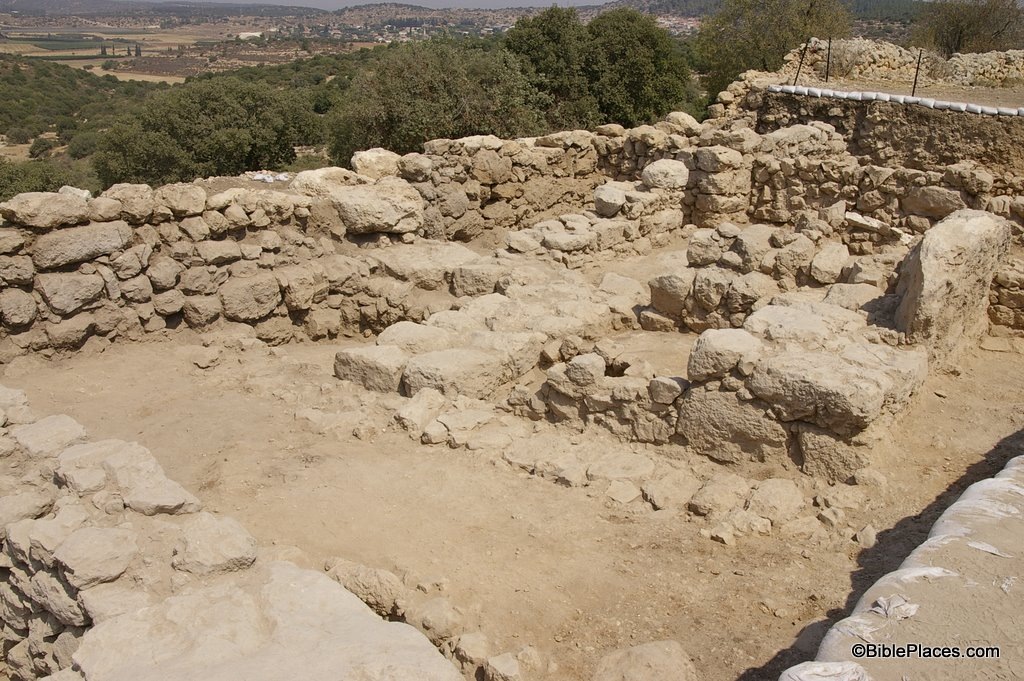
Khirbet Qeiyafa, 10th c four chambered gate, ar080731447

Khirbet Qeiyafa four-chambered gatehouse (10th century B.C.)
Khirbet Qeiyafa stele fragment, ar080731446  Khirbet Qeiyafa excavations with stele fragment
Share: