Zechariah’s Tomb

A 3-minute video has been added to a Jerusalem Post article about a Byzantine church at Khirbet Midras that may have been the traditional site of Zechariah’s tomb. The article was originally posted on February 3rd. Unfortunately the video contains a couple of historical errors (such as referring to the Madaba Map as “a document”[!] that was “recently found”[!!]), but it does provide more information about the site than the article itself. More information about the discovery can be found here and here.

Is this truly the site of Zechariah’s tomb? Given the fact that (so far) there is only circumstantial evidence that the church was dedicated to Zechariah, and the fact that the Byzantines do not hold a very good track record for correctly identifying holy sites … I wouldn’t get my hopes up.

HT: Joseph I. Lauer, Ferrell Jenkins

Lod Mosaic in New York

The New York Review of Books did a recent post on their blog about the Lod Mosaic. It examines the mosaic in detail, and provides several stunning photographs. The mosaic is currently on display in the Metropolitan Museum of Art and is making a tour around the US, traveling from New York to San Francisco, Chicago, and Columbus.

Boston Globe Article on the Western Wall Tunnels

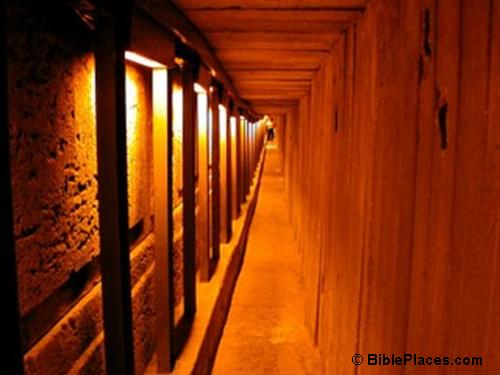
Last Sunday, The Boston Globe posted a brief article about the Western Wall tunnels. The article provides some general information about the wall and its history (both ancient and recent) but contains a couple of errors. (Namely, it states that the Jews worship the Holy of Holies[!], and that the tunnels go under the Temple Mount while in reality they travel alongside the massive retaining wall of the Temple Mount.) However, the article provides details on how you can make a reservation to take a tour and briefly describes what you will see there.

HT: Joseph I. Lauer


Anson Rainey

Of course, one of the biggest news events of the week is that Anson Rainey died on Saturday (as was posted yesterday on this blog). On Friday, interestingly enough, Biblical Archaeology Review posted a lengthy statement by Rainey in the “Scholar’s Study” section of their website. In this statement, he defends himself against recent accusations made by William Dever that he is not an archaeologist. 

The statement provides a survey of Rainey’s archaeological experience and his contributions to the field. The introduction to Rainey’s statement can be found here. The actual statement can be found here.

Mummies in Milwaukee

The Mummies of the World exhibit is currently being displayed in the Milwaukee Public Museum

This is “the largest exhibition of mummies and related artifacts ever assembled.” It will be in
Milwaukee until May 30th.

Bible Alive Seminar in Dallas

For those of you who live in the Dallas area, the Bible Alive seminar is coming to Park Cities Presbyterian Church on April 1-2. This two day event is “a multimedia contextual immersion experience in understanding God’s Word in its original historical, cultural, geographical, literary, and visual context.” The seminar was put together by Preserving Bible Times and will be taught by Doug Greenwold. More information about this event can be found here.

Share:

Construction work in the Dome of the Chain on the Temple Mount gets attention from Arutz-7.

Muslim religious authorities are concluding a clandestine eight-month dig on the Temple Mount that is intended to erase traces of the Jewish Temple’s Altar, Temple activists charge.
The digs have been taking place under the Dome of the Chain, believed to have been built over 1300 years ago. For eight months, the dome – which has a diameter of 14 meters – has been surrounded by a metal fence and black cloth, which hide whatever activity has been going on there from outside inspection. The Muslim Waqf religious authority has claimed the activity is simply a refurbishing of the structure, but refuses adamantly to let Jews or tourists near.

The article includes a couple of additional brief paragraphs along with five photographs.  Several months ago a reader wrote to me about this activity and I replied with speculation that the work consisted of no more than the repair of tiles.  That seems to be confirmed by the photographs.  It’s unfortunate that the Muslims are so secretive, as such only contributes to the suspicion that they are damaging Jewish antiquities.  On the other hand, the charge that the Muslims’ intent is to erase traces of the Temple’s altar is not supported by evidence and seems intended to stir up animosity.

I have located my response mentioned above and am including a portion of it here:


Why was it necessary even to build the plastic construction for a 2nd time so that even the “half cm’s” openings would be closed?

They do the same thing on many Jewish excavations in Jerusalem.  Everyone is just so sensitive.  It doesn’t have to be a problem, just the thought of a problem.  Given the dust-up a couple of years ago with the digging of a trench for a water pipe, I’m not surprised they take every precaution, even if it’s just to replace a few tiles (which is what I bet it is).


Why aren’t we allowed to have a look at least?

Because you might be a biased journalist and write some half-cocked story.  No one is safe from journalists.


What is there to get angry about if I want to take a picture of an open door and a floor with tiles?

See above.


Are they digging under the Dome of the Rock?

Certainly not.  The Dome of the Rock is built on bedrock.  If they wanted to dig under the Dome, they’d do it from inside.  It’s possible they could be accessing some underground cavities (cisterns), but I’d really be surprised if they were doing more than superficial repairs.


How is it possible that Israel cannot go on with their openly work on the ramp to the Mughrabi gate outside the Temple compound, and nobody worries about  secret ‘works’ near the Rock itself? What are they ruining there that we are not allowed to see?

This question seems to suggest that you believe that Middle Eastern matters are treated fairly in the court of world opinion.  That’s as far from the truth as could be.  Why aren’t the Israelis doing something?  My guess is that the cost isn’t worth the gain.  Why cause a fuss over something relatively insignificant that you’re not going to win anyway?

Finally, Leen Ritmeyer explains why he believes that the altar was not located under the Dome of the Chain.  His illustrations will help you put it all together.

Dome of Rock, with Dome of Chain, mat03221

Dome of the Rock with smaller Dome of the Chain (left) in the 1930s (Source)
Share:

There is so much going on that I’m going to start the “Weekend Roundup” today and continue it tomorrow.

Shmuel Browns has posted many photographs of the “Church of Zechariah” at Khirbet Midras that was announced a few days ago.  These photos (here and here) reveal just how well-preserved the mosaic floor is.

In his interview on the LandMinds show, Leen Ritmeyer explains how he determined the location of the original Temple Mount.

On his blog, Leen Ritmeyer addresses “Tunnel-vision politics in Jerusalem” with some helpful photos and a diagram.

Zahi Hawass has an update on the state of Egyptian antiquities.  He is a very important man, as he himself observes, “I am the only source of continuing truth concerning antiquities….I am the guardian of these monuments that belong to the whole world….I want everyone to relax, and know that I am here.”

“An ancient church mentioned in the Bible has been discovered in western Turkey.”  This claim from the excavators of Laodicea is false.  The Bible describes a group of people who met for worship in
Laodicea in the first century (Rev 3:14-22).  The archaeologists found a building where Christians met in the fourth century.

This article in Jewish Ideas Daily points out some of the irony of Ahmadinejad welcoming “home” the Cyrus Cylinder.  I wonder what the chances are that it will ever be returned to the British Museum.

I encourage you to pray for Anson Rainey who is very ill and hospitalized now in Petah Tikva. 

Visiting information was posted on the Agade list (or you may contact me).

HT: Joe Lauer, Daniel Wright, Agade

Share:

From Arutz-7:

A recent report by engineers says that the condition of the Mugrabi Gate is continuously deteriorating and that a few incidents of rocks collapsing from it were recently reported.
The Mugrabi Gate is the only entry point for Jews and other non-Muslims to the Temple Mount.
Jerusalem District Archaeologist Yochanan Zeligman recently addressed a letter to Israel Antiquities Authority Director-General Shuka Dorfman, in which he warned that “a danger exists to the crowd in the women’s section of the Western Wall Plaza, as well to those who walk on the temporary bridge, should stones fall from above.”
The temporary bridge to which Zeligman referred is a wooden pedestrian pathway to the Temple Mount which was constructed in 2007 after a landslide two years earlier made the earthen ramp leading to the Mugrabi Gate unsafe and in danger of collapse. Zeligman’s letter was based on a report he submitted which determined that since the construction in the Mugrabi Gate has not yet been completed, there are sections which are unsupported and could endanger visitors to the site.
Archaeologist Dr. Gabi Barkai, Jerusalem Prize Winner, member of the Committee for the Prevention of the Destruction of Antiquities on the Temple Mount, and lecturer at Bar Ilan University, spoke with Arutz7 on Thursday and expressed his sorrow that the Mugrabi Bridge is not being maintained for illogical political reasons.

The story continues with Barkai giving the background to the ramp.  The Temple Mount was closed to non-Muslims until 2003, not 2008 as stated in the article.

New and old ramp to Temple Mount at Western Wall, tb042605549

New temporary ramp (left) alongside original ramp leading to Mugrabi Gate.  Al Aqsa Mosque and the Mount of Olives are visible in the background.
Share:

Approval of massive renovations at the Western Wall prayer plaza bodes ill for any who like a place for quiet reflection.  On the other hand, the changes will better accommodate the increasing crowds visiting the site.  From the Jerusalem Post:

A new plan to completely renovate the Western Wall Plaza was approved by the Jerusalem Local Planning and Building Committee on Monday, paving the way for the most drastic changes to the layout of the area since the plaza was created after the Six Day War.
“The goal of expanding the entrances and exits of the Western Wall plaza and will give us a solution for allowing large numbers of worshipers and visitors to enter at once, as well as emergency exits,” Rabbi Shmuel Rabinovitch, the chief rabbi of the Western Wall, told The Jerusalem Post.
[…]
The new plan, which is still in the very initial stages of approval, calls for a large underground plaza to replace the current main entrance, located at Dung Gate. A new visitor’s center will replace the current police building, with areas for educational programming, additional bathrooms, an auditorium, lecture halls, and an exhibition space for the archeological discoveries in the area.

The full article is here.  Other stories about the decision can be found here.

Western Wall plaza, tb010910251

Western Wall prayer plaza
Share:

From the Jerusalem Post:

A gag order is being maintained on a sensitive state comptroller’s report believed to blast the lack of Israeli oversight on the Temple Mount, but most of the report is expected to be cleared for publication before the Knesset reconvenes in mid-October, The Jerusalem Post was told Tuesday. The report, which discusses Israel’s authority on the Temple Mount, including governmental oversight of excavations and construction on the site, is viewed as highly sensitive for diplomatic and security reasons, and the first Knesset debate on the report was held Tuesday behind closed doors. The report probes, among other bodies, the performance of the Jerusalem Municipality, the Antiquities Authority, and the Israel Police in enforcing laws and regulations pertaining to the site, as well as the roles of the attorney-general and respective prime ministers in confronting and shaping policy in the face of the challenges posed by the site in recent years. MKs who read the report described it as “all-encompassing” and “very serious”, but noted that the report only concerns the performance of governmental bodies covered within the mandate of the State Comptroller’s Office. The report does not examine the activities of non-governmental bodies, except regarding official bodies’ responses to their actions. “The report revealed many problems that cannot be accepted in a democratic state that tries to prevent – by law – the destruction of a cultural site that is significant, as a world cultural site and a Jewish one,” said MK Otniel Schneller (Kadima), who heads the State Control Committee subcommittee on security, foreign affairs and international trade relations, which was tasked with reviewing the report.

The full story is here.

Share: