Not all archaeologists agree with the recent claims made for the presence of Sea Peoples at Tell Abu al-Kharaz in the Jordan Valley.

Islamic fundamentalists are destroying antiquities in Syria because of their portrayal of human beings.

Wayne Stiles explains how to take a virtual tour of Jerusalem using Google Maps.

Ferrell Jenkins continues his series on Visualizing Isaiah, with recent posts on Isaiah 12, Isaiah 11, Isaiah 10, and Isaiah 9.

The Guardian is looking for photographs from the first excavations of Masada in the 1960s.

Tourism to Israel in January was up 19%, setting a new record.

The ASOR Weekly Roundup has archaeology news from around the world.

For those wondering, we’ll have a separate post on the camels story in the next few days.

HT: Joseph Lauer

Share:

(Post by Seth M. Rodriquez)

Where did Paul’s “fateful trip” finally end?  In a couple of my latest posts, we have been following Paul as he worked his way from Caesarea to Rome as a prisoner. When we last left him, he was on a ship that was intended for Phoenix on the southern coast of Crete, but instead the ship was blown off course and Paul and his companions were shipwrecked on the island of Malta.

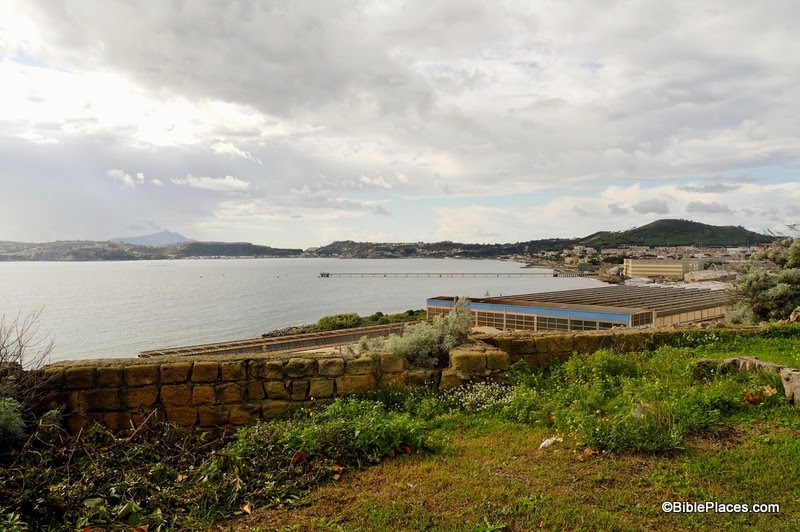
Paul and his companions wintered on Malta (see here and here for pictures). Paul healed many people there and most likely spread the gospel in the area as best he could. When winter was over, Paul and his escort of Roman soldiers were finally able to board another ship and travel to Rome. Our “obscure site” this week is the place where they landed for the last time. After making brief stops at Syracuse and Rhegium, Paul finally ended his long sea journey at the harbor city of Puteoli:

After three months we set sail in a ship that had wintered in the island, a ship of Alexandria, with the twin gods as a figurehead. Putting in at Syracuse, we stayed there for three days. And from there we made a circuit and arrived at Rhegium. And after one day a south wind spring up, and on the second day we came to Puteoli. There we found brothers and were invited to stay with them for seven days. And so we came to Rome. (Acts 28:11-14, ESV.)

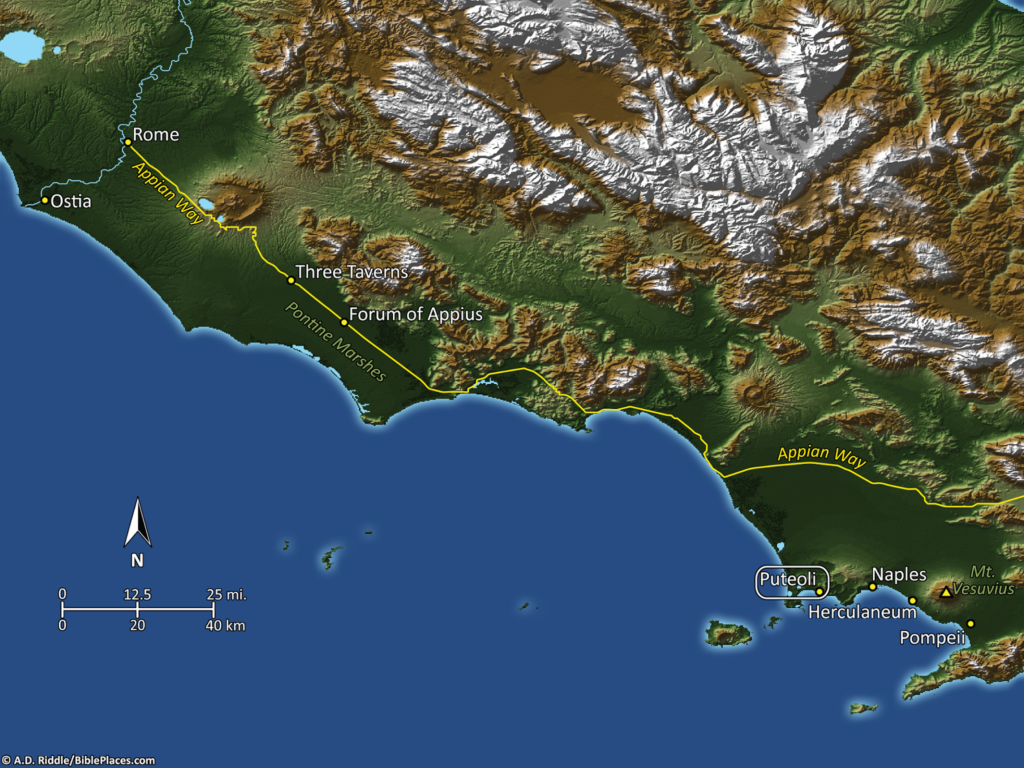
In the map above, Puteoli is located in the bottom right (click on the image to enlarge). Puteoli had a population of about 100,000 people at this time. Its importance was tied to the fact that the Italian Peninsula does not have very many good harbors. Puteoli was one of the few harbors that were deep enough and protected enough to be of much use to the Romans. And since, for many years, it was the closest good harbor to Rome, it was the main harbor of the capital city and commerce streamed in and out of this port. Much of the wealth of the Roman Empire flowed through this spot.


Of course, when we say it was close to Rome, “close” is a relative term. Puteoli actually sits about 150 miles away. From here, Paul had to travel north on the Via Consularis until he reached the city of Capua, and there stepped onto the Appian Way which finally took him to Rome. To continue Paul’s journey and to see a picture of the Appian Way from the PLBL, see my previous post here.


This photograph and map are available in Volume 14 of the Pictorial Library of Bible Lands, and is available here for $24 (with free shipping). Additional images of Puteoli can be seen on the BiblePlaces website here. For other posts in our series on “obscure sites in the PLBL,” see here.
Share:

A fisherman claims that he found the 1100 lb. statue of the Greek god Apollo off the coast of the Gaza Strip. Experts doubt his story, though it is impossible to investigate since Hamas has seized the bronze statue. From The Independent:

Lost for centuries, a rare bronze statue of the Greek god Apollo has mysteriously appeared in the Gaza Strip, only to be seized by police and vanish almost immediately from view.
A local fisherman says he scooped the 500kg, life-sized bronze from the sea bed last August, and carried it home on a donkey cart, unaware of the significance of his catch.
Others soon guessed at its importance, and the statue briefly appeared on eBay with a $500,000 (£300,000) price tag – well below its true value. Police from the Islamist group Hamas say they are investigating.
To their great frustration, archaeologists have not been able to get their hands on the Apollo, and instead must pore over a few blurred photographs of the intact deity, who is laid out incongruously on a blanket emblazoned with Smurfs.
From what they can tell it was cast sometime between the 5th and the 1st century BC, making it at least 2,000 years old.

The full story includes a video and discussion over the provenance of the object. The story is also reported by the Jerusalem Post. Joseph Lauer notes that the Ebay listing for the statue is still online.

A bronze statue of the Greek God Apollo is pictured in Gaza. Lost for centuries, the rare bronze statue of the Greek God Apollo has mysteriously resurfaced in the Gaza Strip
Apollo statue found near Gaza
Photo by Reuters
Share:

Those who studied at the Institute of Holy Land Studies (today Jerusalem University College) or otherwise used the venerable Student Map Manual (SMM) may be interested to know that marking instructions for sections 10, 11, 12, 13 exist. http://ecx.images-amazon.com/images/I/51jIvM97ASL._SL500_SY344_BO1,204,203,200_.jpgThough I used the SMM in the classroom for 11 years (until nary a one was to be bought, borrowed, or stolen), I was unaware that someone had written a sequel to the marking instructions of
James Monson’s The Land Between. Monson’s work only covered the Old Testament periods (through section 9 which ended with the 586 BC destruction of Jerusalem).

In 1992 Frank L. Benz of Wartburg Theological Seminary in Dubuque, Iowa, self-published Holy Land History: A Study Guide to Palestine from the Persian to the Byzantine Periods. This 134-page work follows the marking scheme developed by Monson and proceeds in chronological order. In his acknowledgments, Benz cites his students who asked him, “When will the instructions for the rest of the Manual be prepared so that we can finish the course?” I can only wonder why I never knew of this work, particularly when I was doing graduate work at the Institute from 1992 to 1994.

For those interested, I have scanned the preliminary material of the work including the preface and table of contents. Since the SMM is now difficult to find, this post is more of a historical note than anything else. Those who already own a copy might enjoy reading through Benz’s marking instructions, though I don’t have any advice to give on where such is to be found. (No matches are currently returned at addall.com.)

There are several worthy successors to the SMM and its marking guides for all current and future students of the historical geography of the Bible. I would highlight two resources in particular.

James Monson continues to develop fantastic study resources at Biblical Backgrounds, Inc. His Introductory Study Package includes Regions on the Run and a set of 7 beautiful, large-format maps.

Bill Schlegel recently published the Satellite Bible Atlas. This work is similar in style to the SMM, though the markings are printed on the maps, saving the student a lot of time. The atlas comes with two commentaries. The briefer of these is printed on facing pages of the atlas, making it convenient and ideal for beginning studies. (I am requiring it of all of my OT and NT Survey students at The Master’s College.) The long commentary is valuable for more eager students and is available for free. Both commentaries cover the Intertestamental and New Testament periods.

Share:

The Institute of Culture and Archaeology of the Bible Lands and the Faculty of Theology of Lugano, Switzerland, are hosting on February 20-21, 2014 a research seminar entitled, “The History of the Caves of Qumran.”

The program gives the following description and schedule of lectures.

The Research Seminar is dedicated to the Qumran Caves. Usually archaeological studies focus on the ruins and consider the caves as a background. Our intention is to center the interest on the caves themselves. We’ll consider not only the eleven caves in which the manuscripts were found during the last century, but all the caves that offered archeological material.

In particular, the focus of the seminar is on the identity of each individual cave in comparison with the other caves of Qumran. In addition, the ensemble of Qumran caves will be compared with other caves or findings in the Dead Sea region. Both archeological and textual data will be used in order to provide useful elements to outline the history of use of the caves.


First Session: Topography

M. Fidanzio, General Introduction

J. Taylor, The Qumran Caves in Their Regional Context

J.-B. Humbert, La morphologie des grottes de Qumrân [The morphology of the caves of Qumran]

Second Session: Manuscripts

F. García Martínez, Contents of the Manuscripts from the Caves of Qumran

C. Hempel, The Profile and Character of Qumran Cave 4

E. Puech, La paléographie des manuscrits de Qumrân [The paleography of the Qumran manuscripts]

E. Tov, Scribal Characteristics of the Qumran Scrolls


Third Session: Other Findings

R. Bar Nathan, Pottery From the Qumran Caves

J. Młynarczyk, Terracotta Oil Lamps

O. Shamir and N. Sukenik, The Differences in the Textiles from the Qumran Caves Compared to Those Found in Other Judaean Desert Caves

M. Bélis, Les textiles inédits de Qumrân, fouilles de R. de Vaux: enquête et perspectives 
[Unpublished textiles of Qumran, excavations of R. de Vaux: survey and prospects]

Y. Adler, Leather Tefillin Cases (Phylacteries)

D. Mizzi, Non-Ceramic/Textual Artefacts From the Qumran Caves


Fourth Session: History of Use of the Caves

M. Popovic, When and Why Were the Caves Near Qumran and in the Judaean Desert Used?

J. Magness and J. Zangenberg, The Functions of the Caves and the Settlement of Qumran

The research seminar will be preceded by the Fourth International Conference of TerraSancta on February 19 (mostly in Italian) as well as intensive courses (all in Italian) on February 17–18. More details are available in the program available online here.

For photos of the Qumran caves where Dead Sea Scrolls were found, see our summary here. The Israel Antiquities Authority also has a page explaining the major finds in each cave.

HT: Yonatan Adler

UPDATE (2/25): See this post for a report of Adler’s discovery of nine new manuscripts.
Dead Sea, Qumran, Scroll Caves sign from before 1967, tb021107674
Pre-1967 sign pointing to Dead Sea Scroll caves
Photo from Signs of the Holy Land
Share:

The IAA has launched version 2.0 of the Leon Levy Dead Sea Scrolls Digital Library. The upgraded version includes 10,000 new images.

This looks like a valuable resource: Syria Photo Guide—A Comprehensive Guide to the Cultural and Historical Sites of Syria.

Excavations in Jerusalem’s Liberty Bell Park uncovered a quarry, a winepress (2nd c. AD), and a storage cave (1st c. BC).

An ‘Antilla’ well from the Byzantine period has been discovered in Tel Aviv.

The Assyrians: Masters of War, a 25-minute episode from the Discovery Channel is online.

The Ancient Near East Today has begun its second year of monthly e-newsletters. If you haven’t signed up already, you can do so here.

The update volume for The New Encyclopedia of Archaeological Excavations in the Holy Land is on sale for $90. That’s the cheapest I’ve seen it. Until Feb 11. (Amazon: $130.)

Today is International Septuagint Day.

HT: Seth Rodriquez, Jack Sasson

iaa-dss-psalms
Psalms Scroll from Cave 11
Image taken from the
Leon Levy Dead Sea Scrolls Digital Library
Share: