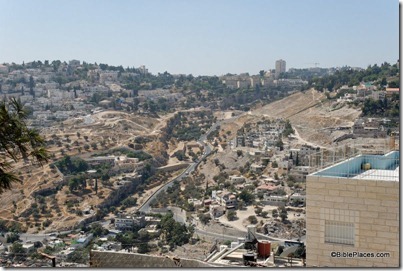
"A small portion of the Western Wall of the Temple Mount is exposed in a courtyard in the Muslim Quarter.  The government of Israel has now declared that it is not subject to the protections given to a “holy site.”  From Arutz-7:

The State’s representatives have determined that the "Kotel HaKatan" ("Small Kotel" or "Small Wailing Wall"), a wall which is a continuation of the Kotel in Jerusalem, is not a holy site. The statement was submitted to the court as part of the reply to a damages lawsuit filed by a group of Jews who prayed at the Small Kotel on Rosh HaShana of 5767 (2006). One member of the group, Elihu Kleiman, was arrested after he blew the ram’s horn, or shofar. The group of Jews who sued for damages also said they were beaten by police, who denied them their freedom to worship at a holy site.
The "Small Kotel" is nothing but "an inner courtyard of several residential homes in the Muslim quarter," the State determined in its response. Like the Kotel, the Kotel HaKatan is an exposed face of the original western wall of the Temple Mount, built by King Herod over 2,000 years ago. However, compared to its famous "bigger brother," the Small Wall is less accessible and looks less impressive: it is barely 10 meters long, less of its height has been exposed and its plaza is much narrower.

The story continues here.  Leen Ritmeyer has commented about the site previously here.

Share:

It’s a bit risky to suggest that a book you have not read or even seen is in the top-ten must-have books on Jerusalem, but I’m willing to be so bold in the case of Ronny Reich’s new book, Excavating the City of David.  Given how quickly Jerusalem’s history “changes” as new archaeological discoveries are made, it is not all that daring to suggest that the newest book is one of the most important.  But I believe that the book will be a classic on the subject because it is written by the lead excavator of the longest running excavations ever in the City of David.  Ronny Reich, Excavating the City of David

Since 1995, Reich has been working with Eli Shukrun in numerous areas throughout the most ancient portion of the city of Jerusalem. 

They have excavated the area of the Gihon Spring where they discovered the Spring and Pool Towers.  They cleared and re-dated the Siloam Channel and made new discoveries concerning the origin of Warren’s Shaft.  In 2004, Reich and Shukrun discovered and revealed the first-century Pool of Siloam.  In recent years, they have excavated the ancient street leading from the pool to the Temple Mount.

Sixteen years of often year-round excavation far exceeds the seven years of Kathleen Kenyon’s work (1961-67) or the eight years of Yigal Shiloh (1978-85). Reich also benefits from learning from the history of many dozens of excavations in Jerusalem (good and bad), and he has the latest archaeological tools to guide his research.


Excavating the City of David is published by the Israel Exploration Society and includes 384 pages and 207 illustrations.  The book has two major sections (see details below in table of contents).  The first reviews the history of excavation in the last 150 years.  The second is a brief history of the City of David.  The work collects the findings published in various articles (Hebrew and English) over the last 15 years, and it almost certainly includes new data and interpretations of the latest finds.

This book will be a major reference in the field for decades to come.  It is available now for about $50 from the Biblical Archaeology Society and as a pre-order from Eisenbrauns.  (It is not listed at Amazon.)


Table of Contents:

Introduction

The City of David–the archaeologists’ creation

The City of David: The History of its Excavation and Study

The Gihon Spring and the pool

Under Ottoman rule

  • Charles Warren
  • Charles Clermont-Ganneau
  • Conrad Schick and the discovery of the Siloam Inscription
  • Hermann Guthe, Conrad Schick and the discovery of Channel II
  • E. Masterman and C.A. Hornstein and Channel I
  • Frederick Jones Bliss and Archibald Dickie
  • Montague B. Parker and Father Louis H. Vincent
  • Raymond Weill

During the British mandatory period

  • The International Excavation Project
  • Robert A.S. Macalister and J. Garrow Duncan
  • John Winter Crowfoot and Gerald M. Fitzgerald

During the period of the divided city (1948-1967)

  • Kathleen M. Kenyon

After reunification of Jerusalem in June 1967

  • David Ussishkin and the survey of tombs in Silwan
  • David Adan-Bayewitz and Yigal Shiloh
  • Ronny Reich and Eli Shukron
  • Some small-scale excavations
  • Eilat Mazar
  • Doron Ben-Ami and Yana Tchekhanovets

Summary

What next?

A Brief History of the City of David

  • Early days
  • The first city—in the Middle Bronze Age II
  • The Late Bronze Age: “My king has caused his name to dwell in the Land of Jerusalem forever”
  • Biblical traditions: David, Solomon and the United Monarchy
  • Some geographical-historical issues
  • Text vs. pottery sherd
  • The kingdom of Judah
  • The return from Babylonian exile
  • The Early Hellenistic and Hasmonean periods
  • The southern City of David in the Herodian period
  • The Roman destruction of the city
  • The Late Roman period
  • The Byzantine period, the Church of Siloam
  • The Early Islamic period and the renewal of Jewish settlement in the southern part of the city
  • The Middle Ages—The Mameluke period and the reopening of the spring
  • The Ottoman period

Epilogue

Acknowledgements

Appendices

Chronological Table

Selected bibliography

Index

Index of textual references

Illustration credits

Share:

There have been a number of articles published within the past few months, all of which are related to the content of this blog.

Galil, Gershon.
2009 “The Hebrew Inscription from Khirbet Qeiyafa/Neta’im: Script, Language, Literature and History.” Ugarit-Forschungen 41: 193-242.

I have not read this article yet, but presumably this is Galil’s formal publication of his reading of the Qeiyafa ostracon and of his identification of Kh. Qeiyafa as Netaim, both of which were mentioned previously by Todd (inscription and identification).

Beitzel, Barry J.
2010 “Was There a Joint Nautical Venture on the Mediterranean Sea by Tyrian Phoenicians and Early Israelites?” Bulletin of the American Schools of Oriental Research 360: 37-66.

de Canales, F. González; L. Serrano; and J. Llompart.
2010 “Tarshish and the United Monarchy of Israel.” Ancient Near Eastern Studies 47: 137-164.

Both of these articles argue for the plausibility of Phoenician nautical trade on the Mediterranean Sea in the 10th century B.C. Beitzel argues that the Hebrew expression ’onî taršîš in 1 Kings 10:22 is better translated “ships of Tarshish” as in the ESV, and not “trading ships” as in the NIV. He gathers together the evidence for early Phoenician trading on the Mediterranean and suggests Tarshish was located in the western Mediterranean. De Canales et al. identify Tarshish more specifically with Huelva, Spain, and date the earliest excavated levels to 900-770 B.C., while proposing an even earlier Phoenician presence.

The latest issue of Israel Exploration Journal contains three articles which may be of interest to our readers.

Rendsburg, Gary A. and William M. Schniedewind.
2010 “The Siloam Tunnel Inscription: Historical and Linguistic Perspectives.” Israel Exploration Journal 60/2: 188-203.

Rendsburg and Schniedewind argue that three linguistic peculiarities of the Siloam inscription point to the dialect of the Northern Kingdom of Israel (referred to as Israelian Hebrew). They go on to speculate that the inscription was authored by a refugee from the northern kingdom, and that the purpose of the tunnel may have been to divert water to the refugee population on the Western Hill.


Siloam Tunnel Inscription in Istanbul, Turkey.

Two more cuneiform inscriptions from Hazor are published in this issue of IEJ as well, one a fragment of an administrative docket and the other a fragment of a clay liver model. (Neither of these are the tablet fragments found last year that Todd reported on here.)

Horowitz, Wayne and Takayoshi Oshima.
2010 “Hazor 16: Another Administrative Docket from Hazor.” Israel Exploration Journal 60/2: 129-132.

Horowitz, Wayne; Takayoshi Oshima; and Abraham Winitzer.
2010 “Hazor 17: Another Clay Liver Model.” Israel Exploration Journal 60/2: 133-145.

These two inscriptions supplement the handy volume of all cuneiform inscriptions found in Canaan (up to the date of publication), Cuneiform in Canaan: Cuneiform Sources from the Land of Israel in Ancient Times, by Wayne Horowitz,; Takayoshi Oshima; and Seth Sanders (Jerusalem: Israel Exploration Society, and Hebrew University of Jerusalem, 2006). We should also add to the list:

Horowitz, Wayne and Takayoshi Oshima.
2007 “Hazor 15: A Letter Fragment from Hazor.” Israel Exploration Journal 57: 34-40.

Mazar, Eilat; Wayne Horowitz; Takayoshi Oshima; and Yuval Goren.
2010 “A Cuneiform Tablet from the Ophel in Jerusalem.” Israel Exploration Journal 60/1: 4-21.

Share:

Zechariah’s Tomb

A 3-minute video has been added to a Jerusalem Post article about a Byzantine church at Khirbet Midras that may have been the traditional site of Zechariah’s tomb. The article was originally posted on February 3rd. Unfortunately the video contains a couple of historical errors (such as referring to the Madaba Map as “a document”[!] that was “recently found”[!!]), but it does provide more information about the site than the article itself. More information about the discovery can be found here and here.

Is this truly the site of Zechariah’s tomb? Given the fact that (so far) there is only circumstantial evidence that the church was dedicated to Zechariah, and the fact that the Byzantines do not hold a very good track record for correctly identifying holy sites … I wouldn’t get my hopes up.

HT: Joseph I. Lauer, Ferrell Jenkins

Lod Mosaic in New York

The New York Review of Books did a recent post on their blog about the Lod Mosaic. It examines the mosaic in detail, and provides several stunning photographs. The mosaic is currently on display in the Metropolitan Museum of Art and is making a tour around the US, traveling from New York to San Francisco, Chicago, and Columbus.

Boston Globe Article on the Western Wall Tunnels

Last Sunday, The Boston Globe posted a brief article about the Western Wall tunnels. The article provides some general information about the wall and its history (both ancient and recent) but contains a couple of errors. (Namely, it states that the Jews worship the Holy of Holies[!], and that the tunnels go under the Temple Mount while in reality they travel alongside the massive retaining wall of the Temple Mount.) However, the article provides details on how you can make a reservation to take a tour and briefly describes what you will see there.

HT: Joseph I. Lauer


Anson Rainey

Of course, one of the biggest news events of the week is that Anson Rainey died on Saturday (as was posted yesterday on this blog). On Friday, interestingly enough, Biblical Archaeology Review posted a lengthy statement by Rainey in the “Scholar’s Study” section of their website. In this statement, he defends himself against recent accusations made by William Dever that he is not an archaeologist. 

The statement provides a survey of Rainey’s archaeological experience and his contributions to the field. The introduction to Rainey’s statement can be found here. The actual statement can be found here.

Mummies in Milwaukee

The Mummies of the World exhibit is currently being displayed in the Milwaukee Public Museum

This is “the largest exhibition of mummies and related artifacts ever assembled.” It will be in
Milwaukee until May 30th.

Bible Alive Seminar in Dallas

For those of you who live in the Dallas area, the Bible Alive seminar is coming to Park Cities Presbyterian Church on April 1-2. This two day event is “a multimedia contextual immersion experience in understanding God’s Word in its original historical, cultural, geographical, literary, and visual context.” The seminar was put together by Preserving Bible Times and will be taught by Doug Greenwold. More information about this event can be found here.

Share:
Every discipline has its champion, its most famous pioneer, the person whom most everybody identifies as being the embodiment of a particular area of study – for the discipline of Historical Geography that person is Edward Robinson.  Robinson, the great explorer and geographer is credited with identifying over 1,000 ancient places names through his knowledge of ancient Near Eastern history and linguistics and his revolutionary usage of toponomy.  However, Edward Robinson was not the only great explorer living in the mid-1800s – there were a few men of great standing, who along with Robinson helped build the foundation of ancient Near Eastern studies for today’s scholarship.  One of those men of great standing was Titus Tobler.

Personal Biography

From Konrad Furrer’s biography on Tobler


Known affectionately as the “Father of German Exploration in Palestine,[1] Titus Tobler (1806-1877), Swiss doctor and 19th century Palestine explorer, was an important figure during the mid-19th century explorations of the Holy Land. 


Over the course of his career Tobler made four expeditions to the Holy Land (1835, 1845, 1857, and 1865) – these expeditions were mostly directed at Jerusalem and its environs.  Tobler came to Palestine the first time as a 29 year-old physician who had just begun to practice medicine in the mountains of Canton of Appenzell [2]  Ten years later, Dr. Tobler returned to the Holy Land and accomplished one of the most in-depth, analytical studies of the region of Judea up until that time.  This expedition had such a positive impact in mid-19th century scholarship that Tobler is considered by historians to be the most important explorer of Jerusalem in the 1840s.[3]  Tobler’s personage and career are thought to be on par with the renowned Edward Robinson by researchers of the 19th century explorers of Palestine.[4]  Tobler was a highly respected explorer and diligently worked on publishing his explorations and translating ancient pilgrim documents up until his death in 1877.[5]


Methodological Developments

Titus Tobler’s Holy Land expeditions and subsequent publications were contemporaneous with other better-known 19th century explorers such as the aforementioned Edward Robinson and the Survey of Western Palestine’s C.R. Conder and H.H. Kitchener.  At first Tobler was dejected at the seemingly overcrowded group of scholars surveying, analyzing, and excavating the Levant in the 19th century.  Despite this, Tobler was able to find his own niche within the broader framework of ancient Levantine studies by combining his own considerable knowledge and research with the concepts and publications of his contemporaries.[6]  Tobler was one of the first to realize that there was no lack of problems to solve in Levantine research.  Tobler concerned himself with more than the general scope of biblical studies and site identification – he began to study “the customs and manners of the people, the nature of the soil and climate, and many other things.”[7] In examining and categorizing these subjects Tobler introduced two scholarly tools into the Holy Land studies: the monograph and the bibliography.[8] 
Notable Discoveries

Wilson’s Arch – The 19th century explorer is most well known for discovering and suggesting the function of an arch from the Herodian Temple Mount to the Western Hill of Jerusalem.  Today this arch is known as “Wilson’s Arch” after Charles Wilson who published it, but Wilson would not have known about the arch unless Tobler had showed it to him.[9]   

“Wilson’s Arch” 2010


The “First Wall” inside of Bishop Gobat’s School (modern day Jerusalem University College) – Tobler correctly identified the remains of Josephus’ “First Wall”[10] that runs along the rocky cliffs of the southwestern part of the Western Hill above the Hinnom Valley.
The First Wall runs beneath the Bishop Gobat School (today’s Jerusalem University College) structure and continues through the Protestant Cemetery (to the right of the school – east)

Quotes pertaining to Titus Tobler

Ben-Arieh shows Tobler’s perspective of other scholars as he quotes Tobler as saying, “Rivalry between explorers increases knowledge.”[11] 
 

Hilprecht compares Edward Robinson and Titus Tobler’s historical impact by writing the following, “As an historical topographer Titus Tobler perhaps accomplished still more than Robinson.”[12]


Tobler’s methodology and work ethic was summed up by Johannes Nepomuk Sepp (1816-1909)[13] as follows:
“A welcome incident brought me to meet Dr. Titus Tobler.  I still remember vividly the first meeting, after which we, without knowing each other, went to sleep for some hours after the celebration of the Nativity in the vault of the monastery in Bethlehem, beside a murderer running away from Egypt.  I knelt before the altar of Christ’s birth full of emotions I had never felt before, as a man to my left started measuring the steps with a measuring cord and a folding measure: one could think that he wanted to make sure that until his next visit the Holy Grotto would not be replaced: this was Tobler.  We both thought that we were opposite characters and suited to complement each other conscientiously; anyhow we considered ourselves to be an opening a new chapter in the history of Palestine pilgrims, I applauded with the fullest appreciation his extreme thoroughness; only a German can work as diligently as he…Never were greater scientific results achieved for smaller financial expense as by Tobler, who is suited to the task by his tough perseverance and effort.” [14]
Regarding the importance of Tobler’s life work Benzinger writes the following, “To this very day he who desires to concern himself with the history of these places must begin with Tobler’s investigations.”[15]
With reference to Tobler’s bibliography Gage writes, “Tobler is the first living authority, so far as the literature of Palestine is concerned; and no man has gone through more painstaking efforts than he, to extend the area of our knowledge respecting the Holy Land.”[16]
Hilprecht discusses the nature of Tobler’s bibliography as he records,
“Besides what he observed and found in the land itself, we must not forget what he accomplished at home in investigating the old descriptions of travels. One of his favorite wishes was to publish all descriptions of travels from the third to the fifteenth century in the most carefully edited form possible. This project he could, however, carry out only in a fragmentary way, and mostly at his own expense.  His excellent annotations made a number of the old writings for the first time really serviceable.”[17]

Additional Info:


For a complete list of Tobler’s 62 publications concerning Palestine refer to: Stern, S. and Haim, Goren. “A Bibliography.” Cathedra 48 (1988): 46-48.

See here for an English translation of Tobler’s bibliography of ancient Holy Land travelers (Appendix III – pages 391-411)


Check out one of Tobler’s maps of Jerusalem from Hebrew University’s database.
[1] Yehoshua Ben-Arieh, The Rediscovery of the Holy Land in the Nineteenth Century, (Jerusalem: Magnes Press, Hebrew University, Israel Exploration Society, 1979). 133.  H.V. Hilprecht, Exploration in Bible Lands During the 19th Century, (A.J. Holman & Co.: Philadelphia, 1903.) 585.
[2] Ibid, 588.
[3] Ibid, 133, 139, 177.  Haim Goren, “British Surveyors in Palestine and Syria: 1840-1841,” Tel Hai Academic College (2005): 7.
[4] Ibid, 590-591.
[5] Ibid, 177.
[6] Ibid, 74. And Ibid, 585.
[7] Ibid, 590.
[8] Ibid, 57.
[9] Dan Bahat, “Jerusalem Down Under: Tunneling Along Herod’s Temple Mount Walll” BAR 26 1 (1995): 32.
[10] For more information on the “First Wall” and its course see David Tarler and Jane Cahill, “The City of David,” The Anchor Bible Dictionary. 6 vols. Edited by David Noel Freedman, (New York: Doubleday, 1992.) 2:60.
[11] Ibid, 74.
[12] Ibid, 588.
[13] A Catholic Historian from Munich, who visited Palestine for the first time in 1845, and became famous as a leading, though controversial figure in German Holy Land research until the end of the century.  Ibid, 60.
[14] Quoted in Ibid, 60 from Johannes Sepp,  Jerusalem und das heilige Land, Pilgerbuch nach Palastina, Syrien und Aegypten, (Schauffhausen, 1863.) 8-9.
[15] J. Benzinger, “Researches in Palestine,” Explorations in Bible Lands during the 19th Century, Philadelphia (1903): 589.
[16] Ibid 391.
[17] Ibid, 590.

 
@font-face {
font-family: “Courier New”;
}@font-face {
font-family: “Wingdings”;
}@font-face {
font-family: “Cambria”;
}p.MsoNormal, li.MsoNormal, div.MsoNormal { margin: 0in 0in 10pt; font-size: 12pt; font-family: “Times New Roman”; }p.MsoFootnoteText, li.MsoFootnoteText, div.MsoFootnoteText { margin: 0in 0in 0.0001pt; font-size: 12pt; font-family: “Times New Roman”; }span.MsoFootnoteReference { vertical-align: super; }p.MsoListParagraph, li.MsoListParagraph, div.MsoListParagraph { margin: 0in 0in 10pt 0.5in; font-size: 12pt; font-family: “Times New Roman”; }p.MsoListParagraphCxSpFirst, li.MsoListParagraphCxSpFirst, div.MsoListParagraphCxSpFirst { margin: 0in 0in 0.0001pt 0.5in; font-size: 12pt; font-family: “Times New Roman”; }p.MsoListParagraphCxSpMiddle, li.MsoListParagraphCxSpMiddle, div.MsoListParagraphCxSpMiddle { margin: 0in 0in 0.0001pt 0.5in; font-size: 12pt; font-family: “Times New Roman”; }p.MsoListParagraphCxSpLast, li.MsoListParagraphCxSpLast, div.MsoListParagraphCxSpLast { margin: 0in 0in 10pt 0.5in; font-size: 12pt; font-family: “Times New Roman”; }span.FootnoteTextChar { font-family: “Times New Roman”; }div.Section1 { page: Section1; }ol { margin-bottom: 0in; }ul { margin-bottom: 0in; }

Share:

Construction work in the Dome of the Chain on the Temple Mount gets attention from Arutz-7.

Muslim religious authorities are concluding a clandestine eight-month dig on the Temple Mount that is intended to erase traces of the Jewish Temple’s Altar, Temple activists charge.
The digs have been taking place under the Dome of the Chain, believed to have been built over 1300 years ago. For eight months, the dome – which has a diameter of 14 meters – has been surrounded by a metal fence and black cloth, which hide whatever activity has been going on there from outside inspection. The Muslim Waqf religious authority has claimed the activity is simply a refurbishing of the structure, but refuses adamantly to let Jews or tourists near.

The article includes a couple of additional brief paragraphs along with five photographs.  Several months ago a reader wrote to me about this activity and I replied with speculation that the work consisted of no more than the repair of tiles.  That seems to be confirmed by the photographs.  It’s unfortunate that the Muslims are so secretive, as such only contributes to the suspicion that they are damaging Jewish antiquities.  On the other hand, the charge that the Muslims’ intent is to erase traces of the Temple’s altar is not supported by evidence and seems intended to stir up animosity.

I have located my response mentioned above and am including a portion of it here:


Why was it necessary even to build the plastic construction for a 2nd time so that even the “half cm’s” openings would be closed?

They do the same thing on many Jewish excavations in Jerusalem.  Everyone is just so sensitive.  It doesn’t have to be a problem, just the thought of a problem.  Given the dust-up a couple of years ago with the digging of a trench for a water pipe, I’m not surprised they take every precaution, even if it’s just to replace a few tiles (which is what I bet it is).


Why aren’t we allowed to have a look at least?

Because you might be a biased journalist and write some half-cocked story.  No one is safe from journalists.


What is there to get angry about if I want to take a picture of an open door and a floor with tiles?

See above.


Are they digging under the Dome of the Rock?

Certainly not.  The Dome of the Rock is built on bedrock.  If they wanted to dig under the Dome, they’d do it from inside.  It’s possible they could be accessing some underground cavities (cisterns), but I’d really be surprised if they were doing more than superficial repairs.


How is it possible that Israel cannot go on with their openly work on the ramp to the Mughrabi gate outside the Temple compound, and nobody worries about  secret ‘works’ near the Rock itself? What are they ruining there that we are not allowed to see?

This question seems to suggest that you believe that Middle Eastern matters are treated fairly in the court of world opinion.  That’s as far from the truth as could be.  Why aren’t the Israelis doing something?  My guess is that the cost isn’t worth the gain.  Why cause a fuss over something relatively insignificant that you’re not going to win anyway?

Finally, Leen Ritmeyer explains why he believes that the altar was not located under the Dome of the Chain.  His illustrations will help you put it all together.

Dome of Rock, with Dome of Chain, mat03221

Dome of the Rock with smaller Dome of the Chain (left) in the 1930s (Source)
Share: