Every discipline has its champion, its most famous pioneer, the person whom most everybody identifies as being the embodiment of a particular area of study – for the discipline of Historical Geography that person is Edward Robinson.  Robinson, the great explorer and geographer is credited with identifying over 1,000 ancient places names through his knowledge of ancient Near Eastern history and linguistics and his revolutionary usage of toponomy.  However, Edward Robinson was not the only great explorer living in the mid-1800s – there were a few men of great standing, who along with Robinson helped build the foundation of ancient Near Eastern studies for today’s scholarship.  One of those men of great standing was Titus Tobler.

Personal Biography

From Konrad Furrer’s biography on Tobler


Known affectionately as the “Father of German Exploration in Palestine,[1] Titus Tobler (1806-1877), Swiss doctor and 19th century Palestine explorer, was an important figure during the mid-19th century explorations of the Holy Land. 


Over the course of his career Tobler made four expeditions to the Holy Land (1835, 1845, 1857, and 1865) – these expeditions were mostly directed at Jerusalem and its environs.  Tobler came to Palestine the first time as a 29 year-old physician who had just begun to practice medicine in the mountains of Canton of Appenzell [2]  Ten years later, Dr. Tobler returned to the Holy Land and accomplished one of the most in-depth, analytical studies of the region of Judea up until that time.  This expedition had such a positive impact in mid-19th century scholarship that Tobler is considered by historians to be the most important explorer of Jerusalem in the 1840s.[3]  Tobler’s personage and career are thought to be on par with the renowned Edward Robinson by researchers of the 19th century explorers of Palestine.[4]  Tobler was a highly respected explorer and diligently worked on publishing his explorations and translating ancient pilgrim documents up until his death in 1877.[5]


Methodological Developments

Titus Tobler’s Holy Land expeditions and subsequent publications were contemporaneous with other better-known 19th century explorers such as the aforementioned Edward Robinson and the Survey of Western Palestine’s C.R. Conder and H.H. Kitchener.  At first Tobler was dejected at the seemingly overcrowded group of scholars surveying, analyzing, and excavating the Levant in the 19th century.  Despite this, Tobler was able to find his own niche within the broader framework of ancient Levantine studies by combining his own considerable knowledge and research with the concepts and publications of his contemporaries.[6]  Tobler was one of the first to realize that there was no lack of problems to solve in Levantine research.  Tobler concerned himself with more than the general scope of biblical studies and site identification – he began to study “the customs and manners of the people, the nature of the soil and climate, and many other things.”[7] In examining and categorizing these subjects Tobler introduced two scholarly tools into the Holy Land studies: the monograph and the bibliography.[8] 
Notable Discoveries

Wilson’s Arch – The 19th century explorer is most well known for discovering and suggesting the function of an arch from the Herodian Temple Mount to the Western Hill of Jerusalem.  Today this arch is known as “Wilson’s Arch” after Charles Wilson who published it, but Wilson would not have known about the arch unless Tobler had showed it to him.[9]   

“Wilson’s Arch” 2010


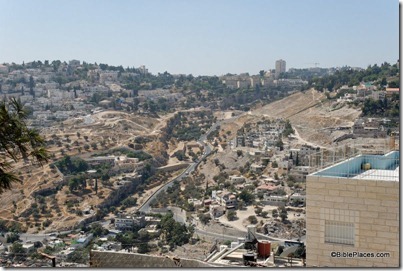
The “First Wall” inside of Bishop Gobat’s School (modern day Jerusalem University College) – Tobler correctly identified the remains of Josephus’ “First Wall”[10] that runs along the rocky cliffs of the southwestern part of the Western Hill above the Hinnom Valley.
The First Wall runs beneath the Bishop Gobat School (today’s Jerusalem University College) structure and continues through the Protestant Cemetery (to the right of the school – east)

Quotes pertaining to Titus Tobler

Ben-Arieh shows Tobler’s perspective of other scholars as he quotes Tobler as saying, “Rivalry between explorers increases knowledge.”[11] 
 

Hilprecht compares Edward Robinson and Titus Tobler’s historical impact by writing the following, “As an historical topographer Titus Tobler perhaps accomplished still more than Robinson.”[12]


Tobler’s methodology and work ethic was summed up by Johannes Nepomuk Sepp (1816-1909)[13] as follows:
“A welcome incident brought me to meet Dr. Titus Tobler.  I still remember vividly the first meeting, after which we, without knowing each other, went to sleep for some hours after the celebration of the Nativity in the vault of the monastery in Bethlehem, beside a murderer running away from Egypt.  I knelt before the altar of Christ’s birth full of emotions I had never felt before, as a man to my left started measuring the steps with a measuring cord and a folding measure: one could think that he wanted to make sure that until his next visit the Holy Grotto would not be replaced: this was Tobler.  We both thought that we were opposite characters and suited to complement each other conscientiously; anyhow we considered ourselves to be an opening a new chapter in the history of Palestine pilgrims, I applauded with the fullest appreciation his extreme thoroughness; only a German can work as diligently as he…Never were greater scientific results achieved for smaller financial expense as by Tobler, who is suited to the task by his tough perseverance and effort.” [14]
Regarding the importance of Tobler’s life work Benzinger writes the following, “To this very day he who desires to concern himself with the history of these places must begin with Tobler’s investigations.”[15]
With reference to Tobler’s bibliography Gage writes, “Tobler is the first living authority, so far as the literature of Palestine is concerned; and no man has gone through more painstaking efforts than he, to extend the area of our knowledge respecting the Holy Land.”[16]
Hilprecht discusses the nature of Tobler’s bibliography as he records,
“Besides what he observed and found in the land itself, we must not forget what he accomplished at home in investigating the old descriptions of travels. One of his favorite wishes was to publish all descriptions of travels from the third to the fifteenth century in the most carefully edited form possible. This project he could, however, carry out only in a fragmentary way, and mostly at his own expense.  His excellent annotations made a number of the old writings for the first time really serviceable.”[17]

Additional Info:


For a complete list of Tobler’s 62 publications concerning Palestine refer to: Stern, S. and Haim, Goren. “A Bibliography.” Cathedra 48 (1988): 46-48.

See here for an English translation of Tobler’s bibliography of ancient Holy Land travelers (Appendix III – pages 391-411)


Check out one of Tobler’s maps of Jerusalem from Hebrew University’s database.
[1] Yehoshua Ben-Arieh, The Rediscovery of the Holy Land in the Nineteenth Century, (Jerusalem: Magnes Press, Hebrew University, Israel Exploration Society, 1979). 133.  H.V. Hilprecht, Exploration in Bible Lands During the 19th Century, (A.J. Holman & Co.: Philadelphia, 1903.) 585.
[2] Ibid, 588.
[3] Ibid, 133, 139, 177.  Haim Goren, “British Surveyors in Palestine and Syria: 1840-1841,” Tel Hai Academic College (2005): 7.
[4] Ibid, 590-591.
[5] Ibid, 177.
[6] Ibid, 74. And Ibid, 585.
[7] Ibid, 590.
[8] Ibid, 57.
[9] Dan Bahat, “Jerusalem Down Under: Tunneling Along Herod’s Temple Mount Walll” BAR 26 1 (1995): 32.
[10] For more information on the “First Wall” and its course see David Tarler and Jane Cahill, “The City of David,” The Anchor Bible Dictionary. 6 vols. Edited by David Noel Freedman, (New York: Doubleday, 1992.) 2:60.
[11] Ibid, 74.
[12] Ibid, 588.
[13] A Catholic Historian from Munich, who visited Palestine for the first time in 1845, and became famous as a leading, though controversial figure in German Holy Land research until the end of the century.  Ibid, 60.
[14] Quoted in Ibid, 60 from Johannes Sepp,  Jerusalem und das heilige Land, Pilgerbuch nach Palastina, Syrien und Aegypten, (Schauffhausen, 1863.) 8-9.
[15] J. Benzinger, “Researches in Palestine,” Explorations in Bible Lands during the 19th Century, Philadelphia (1903): 589.
[16] Ibid 391.
[17] Ibid, 590.

 
@font-face {
font-family: “Courier New”;
}@font-face {
font-family: “Wingdings”;
}@font-face {
font-family: “Cambria”;
}p.MsoNormal, li.MsoNormal, div.MsoNormal { margin: 0in 0in 10pt; font-size: 12pt; font-family: “Times New Roman”; }p.MsoFootnoteText, li.MsoFootnoteText, div.MsoFootnoteText { margin: 0in 0in 0.0001pt; font-size: 12pt; font-family: “Times New Roman”; }span.MsoFootnoteReference { vertical-align: super; }p.MsoListParagraph, li.MsoListParagraph, div.MsoListParagraph { margin: 0in 0in 10pt 0.5in; font-size: 12pt; font-family: “Times New Roman”; }p.MsoListParagraphCxSpFirst, li.MsoListParagraphCxSpFirst, div.MsoListParagraphCxSpFirst { margin: 0in 0in 0.0001pt 0.5in; font-size: 12pt; font-family: “Times New Roman”; }p.MsoListParagraphCxSpMiddle, li.MsoListParagraphCxSpMiddle, div.MsoListParagraphCxSpMiddle { margin: 0in 0in 0.0001pt 0.5in; font-size: 12pt; font-family: “Times New Roman”; }p.MsoListParagraphCxSpLast, li.MsoListParagraphCxSpLast, div.MsoListParagraphCxSpLast { margin: 0in 0in 10pt 0.5in; font-size: 12pt; font-family: “Times New Roman”; }span.FootnoteTextChar { font-family: “Times New Roman”; }div.Section1 { page: Section1; }ol { margin-bottom: 0in; }ul { margin-bottom: 0in; }

Share:

Construction work in the Dome of the Chain on the Temple Mount gets attention from Arutz-7.

Muslim religious authorities are concluding a clandestine eight-month dig on the Temple Mount that is intended to erase traces of the Jewish Temple’s Altar, Temple activists charge.
The digs have been taking place under the Dome of the Chain, believed to have been built over 1300 years ago. For eight months, the dome – which has a diameter of 14 meters – has been surrounded by a metal fence and black cloth, which hide whatever activity has been going on there from outside inspection. The Muslim Waqf religious authority has claimed the activity is simply a refurbishing of the structure, but refuses adamantly to let Jews or tourists near.

The article includes a couple of additional brief paragraphs along with five photographs.  Several months ago a reader wrote to me about this activity and I replied with speculation that the work consisted of no more than the repair of tiles.  That seems to be confirmed by the photographs.  It’s unfortunate that the Muslims are so secretive, as such only contributes to the suspicion that they are damaging Jewish antiquities.  On the other hand, the charge that the Muslims’ intent is to erase traces of the Temple’s altar is not supported by evidence and seems intended to stir up animosity.

I have located my response mentioned above and am including a portion of it here:


Why was it necessary even to build the plastic construction for a 2nd time so that even the “half cm’s” openings would be closed?

They do the same thing on many Jewish excavations in Jerusalem.  Everyone is just so sensitive.  It doesn’t have to be a problem, just the thought of a problem.  Given the dust-up a couple of years ago with the digging of a trench for a water pipe, I’m not surprised they take every precaution, even if it’s just to replace a few tiles (which is what I bet it is).


Why aren’t we allowed to have a look at least?

Because you might be a biased journalist and write some half-cocked story.  No one is safe from journalists.


What is there to get angry about if I want to take a picture of an open door and a floor with tiles?

See above.


Are they digging under the Dome of the Rock?

Certainly not.  The Dome of the Rock is built on bedrock.  If they wanted to dig under the Dome, they’d do it from inside.  It’s possible they could be accessing some underground cavities (cisterns), but I’d really be surprised if they were doing more than superficial repairs.


How is it possible that Israel cannot go on with their openly work on the ramp to the Mughrabi gate outside the Temple compound, and nobody worries about  secret ‘works’ near the Rock itself? What are they ruining there that we are not allowed to see?

This question seems to suggest that you believe that Middle Eastern matters are treated fairly in the court of world opinion.  That’s as far from the truth as could be.  Why aren’t the Israelis doing something?  My guess is that the cost isn’t worth the gain.  Why cause a fuss over something relatively insignificant that you’re not going to win anyway?

Finally, Leen Ritmeyer explains why he believes that the altar was not located under the Dome of the Chain.  His illustrations will help you put it all together.

Dome of Rock, with Dome of Chain, mat03221

Dome of the Rock with smaller Dome of the Chain (left) in the 1930s (Source)
Share:

Mark Hoffman is in the process of posting geo-tagged photos from his recent trip to Turkey and Greece

Tom Powers has determined the exact location of the recently discovered Roman bathhouse in the Old City of Jerusalem.

Ferrell Jenkins has returned safely from his trip to Egypt and Israel.  See his recent posts for photos he took along the way.

Leen Ritmeyer continues his explanation of the newly excavated drainage channel next to the Temple Mount.

This Israel MFA article shows you how you can be an “eco-tourist in Israel.”  The conclusion provides a list of a ten GoEco opportunities.  Many of them sound worthwhile and interesting.

The Jerusalem Post has an interview with Kay Wilson, the tour guide who was nearly stabbed to
death while hiking with a friend in the hills west of Jerusalem.

The Dead Sea is not dead.  Some microorganisms are able to survive in the extremely salty conditions.  Most of the brief article at ScienceDaily is technical, but this sentence caught my eye:

“Evolution is not a perfect engineer who plans everything and knows exactly what he wants to create from the outset.” 


Excavating the City of David, by Ronny Reich, is scheduled to be published this spring by the Israel Exploration Society.  Eisenbrauns has the details and is accepting pre-orders.

The best mainstream treatment of the history of ancient Israel is now out in a third edition.  Ancient Israel has chapters written by a dozen scholars and is edited by Hershel Shanks.  The previous edition came out in 1999, so an updated work is needed.  As of this writing, the best price is at the BAS Store.

The latest edition of Atiqot has been published and you can read the articles for free if you register (a quick and easy process).  The article I clicked on to test the process (“A Cairn Field”) turns out to be about a potential high place near Jerusalem in the time of Jeremiah.

Israel’s MFA has the best article I can remember about birds migrating through Israel. “At least 500 million birds of 200 different species fly across Israel each spring and fall.”  The article tells you where to find them and why you might want to.

And a Haaretz reporter is surprised that he/she likes the newly introduced McFalafel.

Share:

There is so much going on that I’m going to start the “Weekend Roundup” today and continue it tomorrow.

Shmuel Browns has posted many photographs of the “Church of Zechariah” at Khirbet Midras that was announced a few days ago.  These photos (here and here) reveal just how well-preserved the mosaic floor is.

In his interview on the LandMinds show, Leen Ritmeyer explains how he determined the location of the original Temple Mount.

On his blog, Leen Ritmeyer addresses “Tunnel-vision politics in Jerusalem” with some helpful photos and a diagram.

Zahi Hawass has an update on the state of Egyptian antiquities.  He is a very important man, as he himself observes, “I am the only source of continuing truth concerning antiquities….I am the guardian of these monuments that belong to the whole world….I want everyone to relax, and know that I am here.”

“An ancient church mentioned in the Bible has been discovered in western Turkey.”  This claim from the excavators of Laodicea is false.  The Bible describes a group of people who met for worship in
Laodicea in the first century (Rev 3:14-22).  The archaeologists found a building where Christians met in the fourth century.

This article in Jewish Ideas Daily points out some of the irony of Ahmadinejad welcoming “home” the Cyrus Cylinder.  I wonder what the chances are that it will ever be returned to the British Museum.

I encourage you to pray for Anson Rainey who is very ill and hospitalized now in Petah Tikva. 

Visiting information was posted on the Agade list (or you may contact me).

HT: Joe Lauer, Daniel Wright, Agade

Share:

This may be a first.  From Ynetnews:

A man chanted anti-Israel slogans upon arriving at the Western Wall in Jerusalem on Monday and spray-painted a pro-Palestinian writing on a nearby wall. The man, in his 30s, was immediately seized by ushers stationed in the area and was later detained for questioning by the police. "A guy of Russian descent, a Hebrew speaker, arrived and began shouting, ‘End the occupation’ and ‘Fascists’," Yigal Levy, the Western Wall Heritage Fund’s operations manager told Ynet. "He pulled out a green spray can and wrote the word ‘Palestine’ in huge letters on the northern wall just next to the Western Wall." Levy added that the man, who committed the act under pouring rain, appeared to be mentally ill.

The full story is here.  Arutz-7 reports on it here.

Share:

The channel from the Western Wall area to the Pool of Siloam is not yet open to the public, but you can get a look inside with photos posted by the Israel Antiquities Authority.  Three high-resolution images are currently available at this page (or try this direct link to the zip file).

You can also watch a 3-minute video posted by the Israel Antiquities Authority, with archaeologist Eli Shukrun showing off the results of seven years of his work.

Share: