Job 39

The Lord Answers

Wild Ox

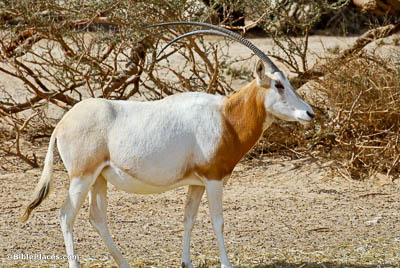
Will the wild ox be willing to serve you? Will it spend the night by your manger? (Job 39:9)

When God finally speaks, he explodes the retribution principle as the governing paradigm of the world. By asking seventy rhetorical questions, Yahweh exposes the severe limitations of human wisdom. Since man is unable to explain so much of how the universe operates, he has no right to deny that God is just. The questions of this chapter focus on God’s knowledge, and Job’s ignorance, of a series of pairs of wild animals.

Most understand the animal mentioned in verse 9 to be the wild ox, or aurochs, but some scholars have suggested that the animal in question may be the oryx. Although the oryx is not as large as the aurochs, it would be large enough for the domestic tasks listed here (such as plowing) if it were capable of being tamed. The Sahara oryx shown here are also known as the Scimitar oryx. In 2000, it was declared extinct in the wild, but captive oryx have since been reintroduced to the wild.
Ostrich Eggs

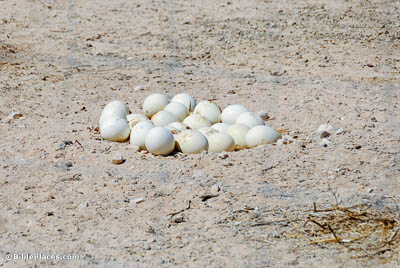
She forgets that they may be trampled under foot, or a wild animal may trample them (Job 39:15).

In the ostrich and warhorse pair discussed in verses 13-25, the Lord gives extended descriptions of creatures that reflect divine brilliance far exceeding anything man would devise. The design of the ostrich is utterly contrary to what man in his wisdom would create. The ostrich has wings but cannot fly. Confined to the ground, it must lay its eggs in the sand, but it is not mindful of them being trampled by the beasts. This is because God did not give the animal wisdom. Would Job ever create such a creature? And yet, in his divine pleasure, God made this goofy-looking creature unbelievably fast, leaving horse and rider in its dust.

Ostriches do have a tendency to abandon their eggs, simply letting them lie on the ground as shown here. A close look at the eggs in this photo (taken at Haibar Nature Reserve) reveals that several of them are cracked and broken.

Horse

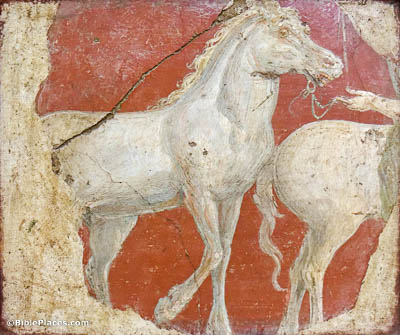
Do you give the horse his strength? Did you clothe his neck with a flowing mane? (Job 39:19)

Nor did Job design the warhorse. He had nothing to do with the horse’s massive strength, beautiful mane, or powerful legs. But God created this magnificent beast eager for battle, ready to charge into the fray, heedless of the deadly weapons flashing around him. The Lord’s vivid description reflects his delight in the unique qualities he gave to this creature. But of this, Job knows nothing.

This fresco comes from Villa Ariadne (Arianna) at Stabiae, a city on the coast near Pompeii that was also destroyed in the eruption of Mount Vesuvius in AD 79. It depicts a white horse being led by a bridle and reins. This fresco was photographed at the Naples Archaeological Museum.

Hawk

Is it by your understanding that the hawk soars, spreading his wings toward the south? (Job 39:26)

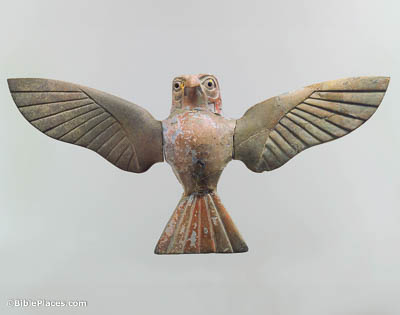
Finally, the Lord asks Job if it is by his wisdom that the hawk soars high above the earth. Was it Job who commanded the eagle to build his nest high on the rocky crags? Did Job create this bird’s marvelous eyesight that could spy a rodent from the heights and then enable him to swoop down to bring food back to his young?

This ivory plaque (circa 1800 BC) was once part of a furniture inlay that depicted a hawk (technically a peregrine falcon, going by the cheek markings) grasping deer in both talons. This image comes from The Metropolitan Museum of Art and is in the public domain (Gift of Mrs. George D. Pratt, in memory of George D. Pratt, 1937, accession number 37.143.6).

Carrion

Wherever the dead carcasses are, there is he (Job 39:30).

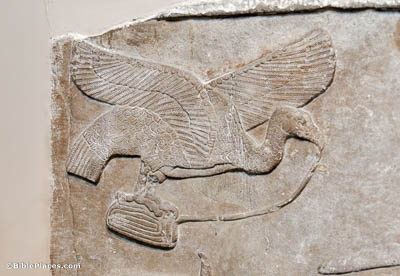
Both the first and last pairs in the Lord’s speech draw attention to the role that death plays in life. The raven chicks and the eaglets feast on the blood of dead animals for their nourishment. Does Job understand how such “evil” works out in God’s design? A narrow view of a rabbit’s being killed by an eagle makes no sense, but there is a bigger picture unseen to the rabbit’s family. Similarly, God’s questions reveal to Job how foolish he has been in questioning the one who has a complete understanding of his wise plan.

This relief from the Central Palace at Nimrud (circa 728 BC) depicts a vulture flying away with the entrails of a soldier killed on the battlefield. It was photographed at the British Museum.

Purchase the Collection:

Job (Photo Companion to the Bible)

FREE Shipping plus Immediate Download